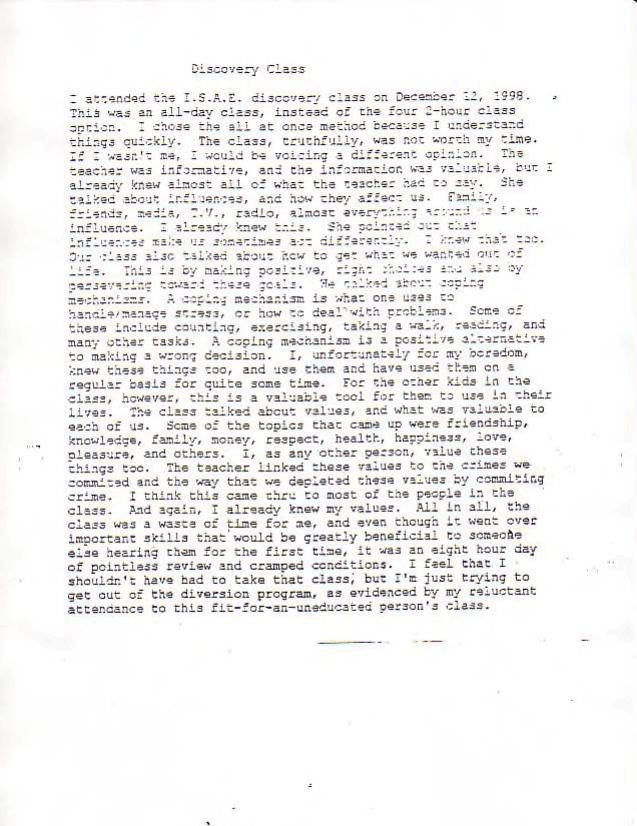
I attended the I.S.A.E. discovery class on December 12, 1998. This was an all-day class, instead of four 2-hour options. I chose the all in once method since I understand things quickly. The class, truthfully, was not worth my time. If I wasn’t me, I would be voicing a different opinion. The teacher was informative, and the information was valuable, but I already knew almost all of what the teacher had to say. She talked about influences and how they affect us. Family, friends, media, T.V., radio, almost everything around is an influence. I already knew this. She pointed out that influences make us sometimes act differently. I knew that too. Our class also talked about how to get what we wanted out of life. This is by making positive, right choices and also by persevering towards there goals. We talked about coping mechanisms. A coping mechanism is what one uses to handle/manage stress, or how to deal with problems. Some of these include counting, exercising, taking a walk, reading, and many other tasks. A coping mechanism is a positive alternative to making a wrong decision. I, unfortunately for my boredom, knew these things too, and use them and have used them on a regular basis for quite some time. For the other kids in the class, however, this is a valuable tool for them to use in their lives. The class talked about values, and what was valuable of each of us. Some of the topics that came up were friendship, knowledge, family, money, respect, health, happiness, love, pleasure and others. I, as any other person, value these things too. The teacher linked these values to the crimes we committed and the way that we depleted these values by committing crime. I think this came thru to most of the people in the class. And again, I already knew my values. All in all, the class was a waste of time for me, and even though it went over important skills that would be greatly beneficial to someone else hearing them for the first time, it was an eight hour day of pointless review and cramped conditions. I feel that I shouldn’t have had to take that class, but I’m just trying to get out of the diversion program, as evidenced by my reluctant attendance to this fit-for-an-uneducated person’s class.
My opinion
Dylan Klebold’s assignment from his Diversion Files provides a striking window into his mindset with authority figures. On the surface, it’s a simple reflection on an all-day I.S.A.E. discovery class, designed to teach coping mechanisms, goal-setting, and the importance of personal values. But the tone and subtext reveal something far more revealing: a young man who feels above the system, detached from moral guidance, and resistant to authority.
From the start, Dylan positions himself as superior. He writes, “If I wasn’t me, I would be voicing a different opinion,” and calls the class “a waste of time for me.” While he acknowledges the value of the material… such as understanding influences, employing coping mechanisms, and recognizing values like friendship, family, and respect, he stresses that he already knew all of it. To him, the lessons are only useful for “other kids,” leaving him bored, dismissive, and emotionally disengaged for the whole day.
This pattern of detachment continues throughout the assignment. He describes coping mechanisms he’s “used…for quite some time,” and asserts, “I already knew my values.” He understands the concepts being taught but refuses to internalize them personally. Even when the class discusses the connection between values and “the crimes we committed,” he frames it analytically rather than emotionally, maintaining a somewhat distance from accountability or personal reflection. However his apology letter has never been released, which would have been interesting to compare it to. However we do know he had to rewrite it from the files.
The assignment also underscores his resistance to authority and reluctance to engage with intervention programs. Dylan emphasizes that his attendance is motivated only by a desire to exit the diversion program, and he repeatedly undermines the authority of the teacher and the class itself, describing it as “fit-for-an-uneducated person’s class.” This combination of intellectual understanding and emotional detachment points to a troubling pattern: he is aware of moral and social norms but deliberately places himself outside them.
Reading this piece, we see a young man who IS intelligent and perceptive yet disengaged, superior in his own estimation, and unwilling to apply the lessons he understands. There are early signs of cynicism and isolation. Knowledge exists without empathy; awareness exists without accountability. This is what I get from it in my opinion and it’s interesting to see just how complex he actually is.
 Echoes in the Columbine Archive
Leave a comment