
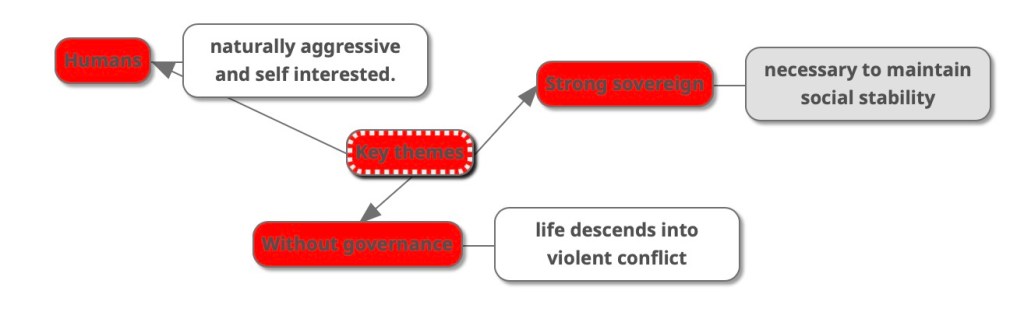
Hobbes was an English philosopher, best known for Leviathan (1651). He believed that in a “state of nature” that is, without governance, humans are inherently self-interested, competitive, and prone to conflict. Life in this natural state, he argued, would be “solitary, poor, nasty, brutish, and short.” To avoid this chaos, Hobbes argued that society needs a strong sovereign to enforce laws and preserve order.
In Hobbes’ positivist system, laws derive their authority from the sovereign, not from morality or religion.
His ideas were groundbreaking for the time. Hobbes argued that social order requires a strong central authority, offering a rational, non-religious basis for government. In a period of social and political turmoil, he argued, a single strong ruler was the best safeguard against anarchy and civil war.
“In the state of nature, profit is the measure of right.”
“During the time men live without a common power to keep them all in awe, they are in that condition which is called war; and such a war as is of every man against every man.”
“Covenants, without the sword, are but words and of no strength to secure a man’s peace.”
“The condition of man… is a condition of war of everyone against everyone.”
Possible misinterpretation
Harris may have focused on the idea that humans are naturally violent while overlooking Hobbes’ central argument: aggression must be restrained by authority and societal rules. By ignoring this, he could have used Hobbes’ ideas to justify his own violent ambitions and ideations.
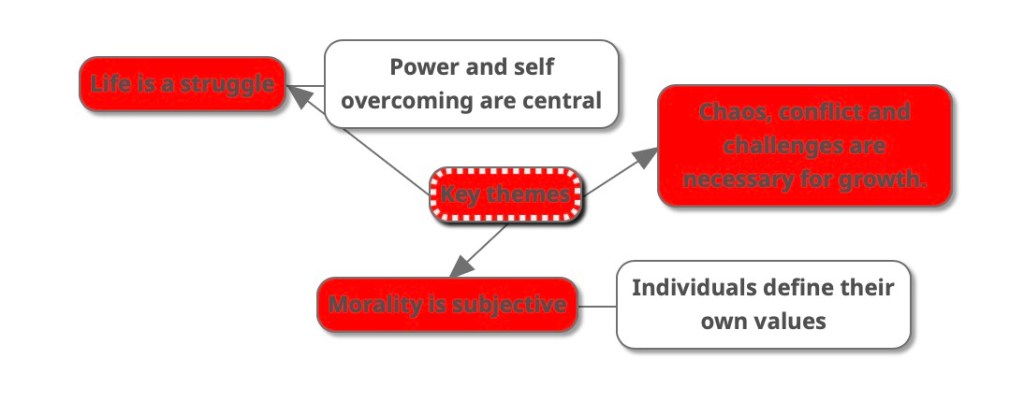
Friedrich Nietzsche was a German philosopher who explored morality, power, and individualism. He argued that strong individuals create their own values and rise above conventional ethical systems. Central to his thought is the “will to power”, the drive to assert oneself, overcome obstacles, and achieve greatness on one’s own terms. He saw life as a struggle that requires self-overcoming and the courage to define one’s own path, even in a world without inherent moral absolutes.
Nietzsche’s work was groundbreaking because it challenged long standing moral, religious, and philosophical beliefs, paving the way for existentialism, modern psychology, and critiques of authority
“He who fights with monsters should be careful lest he thereby become a monster.”
“That which does not kill us makes us stronger.”
“One must still have chaos in oneself to be able to give birth to a dancing star.”
“The individual has always had to struggle to keep from being overwhelmed by the tribe… no price is too high to pay for the privilege of owning yourself.”
Possible misinterpretation
Nietzsche promotes self-creation and personal power. Harris may have read his writings as a license for aggression and domination, focusing on ideas of power and exceptionalism while ignoring Nietzsche’s ethical subtleties.
What more?
Both philosophers contain ideas that could appeal to a mind like Harris’s but only when stripped of context.
Hobbes emphasizes human aggression but stresses the need for societal restraint; Nietzsche emphasizes individual power but not harming others indiscriminately.
Hobbes, who sought to justify social order through centralized authority, Nietzsche celebrated individual freedom, creativity, and self determination mastery, even in a chaotic or morally indifferent world.
Harris appears to have cherry picked concepts from both, shaping them into a worldview that justified violence and exceptionalism while ignoring the crucial ethical and social dimensions.
Despite him referencing Hobbes and Nietzsche, it’s clear he didn’t engage with either their ideas deeply.
At 17, he was likely using them somewhat to appear intellectual and sophisticated, while selectively picking concepts and parts that justified his worldview.
In many ways, his journal reads like an attempt to play the role of a philosopher, using big ideas to craft a persona of depth and authority.
Which is why I don’t take Harris’s words at face value, or assume his journal reflects who he truly was. He contradicts himself frequently, and much of what he writes seems carefully constructed in his own mind. It’s a persona he wants the world to see.
Someone powerful, intelligent, and dangerous, rather than a lonely outsider who felt he didn’t belong anywhere. His journal is less a transparent window into his psyche and more a deliberate effort to shape his legacy and control how he is remembered.
This is also partly why my research relies on cross comparing everything Harris(Klebold as well) said, wrote, and what others observed about him. By looking at multiple perspectives, it’s possible to build a more nuanced understanding that goes beyond his anger, bravado, and carefully constructed persona. Only through this kind of triangulation can we approach a picture of who he really was, beneath the performance he wanted the world to see.
 Echoes in the Columbine Archive
Leave a comment