“Mr Self Destruct”
I am the voice inside your head
(And I control you)
I am the lover in your bed
(And I control you)
I am the sex that you provide
(And I control you)
I am the hate you try to hide
(And I control you)
I take you where you want to go
I give you all you need to know
I drag you down, I use you up
Mr. Self Destruct
I speak religion’s message clear
(And I control you)
I am denial, guilt, and fear
(And I control you)
I am the prayers of the naive
(And I control you)
I am the lie that you believe
(And I control you)
I take you where you want to go
I give you all you need to know
I drag you down, I use you up
Mr. Self Destruct
You let me do this to you (I am an exit) X7
I am the needle in the vein
I am the high you can’t sustain
I am the pusher, I’m a whore
I am the need in you for more
I am the bullet in the gun
(And I control you)
I am the truth from which you run
(And I control you)
I am the silencing machine
(And I control you)
I am the end of all your dreams
(And I control you)
I take you where you want to go
I give you all you need to know
I drag you down, I use you up
Mr. Self Destruct x2
The song
Mr. Self Destruct” starts the album with intense, harsh energy that immediately shows the emotional tone of the record. The heavy beats, distorted sounds, and rough vocals make you feel the anger and frustration in the song. Lyrically, the narrator seems both in control and out of control both punishing himself while also being forced along by his own thoughts. The track shows feelings of self-hate, isolation, and inner conflict, and it sets the stage for the rest of the album, which explores emotional pain and the struggle with personal breakdown. Its short, fast-paced structure gives the feeling of urgency, like the mind is spinning out of control.
Dylan
Transcript:
Da ThoughtZ Jeah
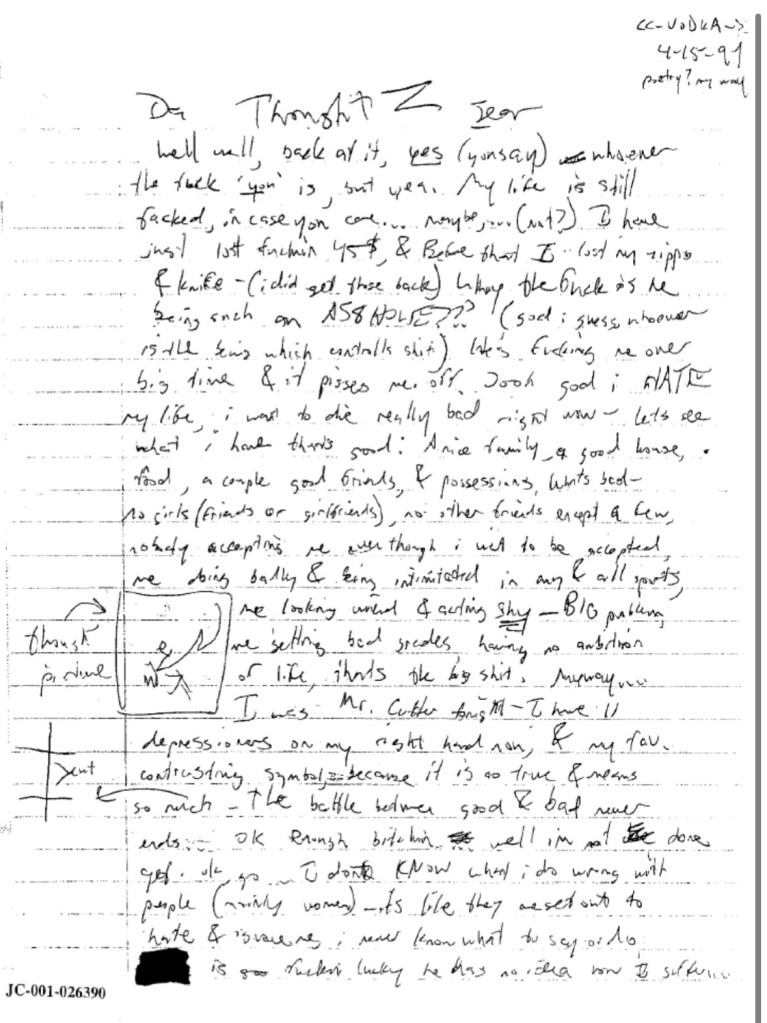
Well well, back at it, yes, (you say) [scribble] whoever the fuck ‘you’ is, but yea. My life is still fucked, in case you care… maybe,… (not?) I have just lost fuckin 45$, & Before that I lost my zippo & knife – (i did get those back) Why the fuck is he being such an ASSHOLE??? (god i guess, whoever is the being which controlls shit) He’s fucking me over big time & it pisses me off. OOOh god i HATE my life, i want to die really bad right now – let’s see what i have that’s good: A nice family, a good house, food, a couple good friends, & possessions. What’s bad: no girls (friends or girlfriends), no other friends except a few, nobody accepting me even though i want to be accepted, me doing badly & being intimidated in any & all sports, me looking wierd & acting shy – BIG problem, me getting bad grades, having no ambition of life, thats the big shit. Anyway… I was Mr. Cutter tonight – I have 11 depressioners on my right hand now, & my fav. contrasting symbol, because it is so true & means so much [sketches in margin labeled ‘thought picture’ and ‘cut’] – The battle between good & bad never ends… OK, enough bitchin… well im not done yet. ok so… I dont know what i do wrong with people (mainly women) – its like they all set out to hate & ignore me, i never know what to say or do,
[edited] is soo fuckin lucky he has no idea how I suffer.
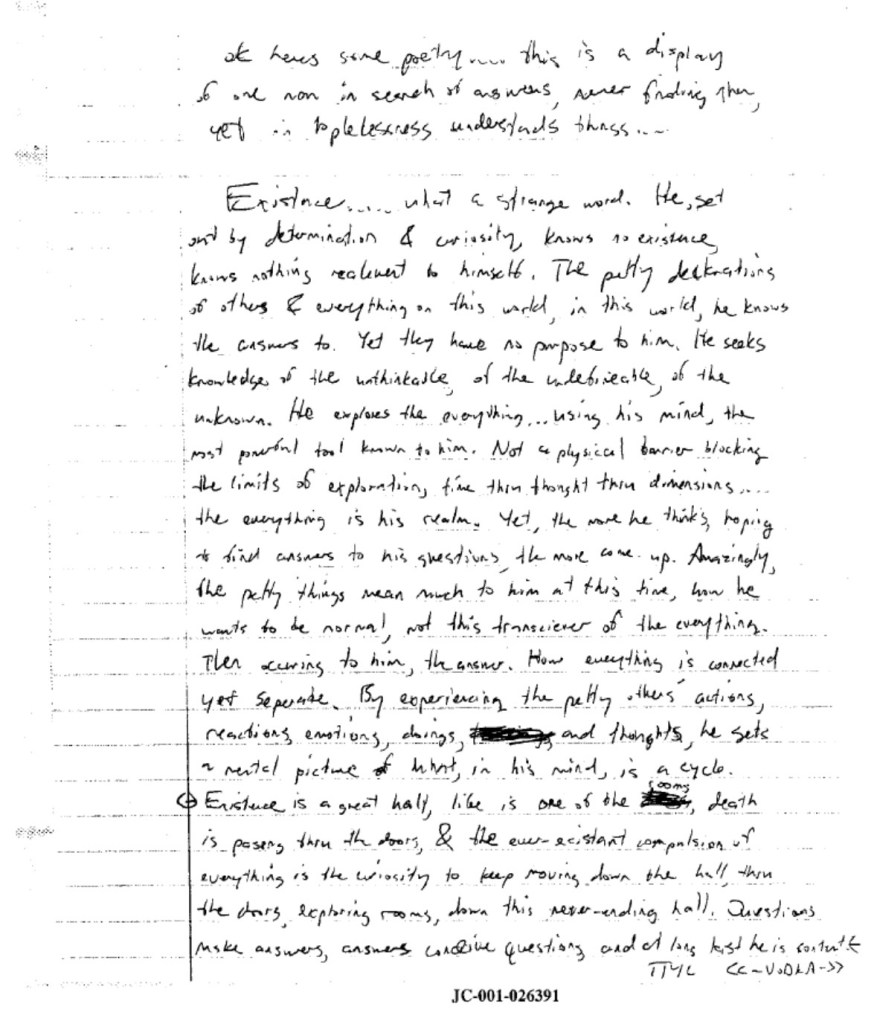
ok here’s some poetry… this is a display of one man in search of answers, never finding them, yet in hopelessness understands things…
Existence….. what a strange word. He, set out by determination & curiosity, knows no existence, knows nothing realevent to himself. The petty destinations of others & everything on this world, in this world, he knows the answers to. Yet they have no purpose to him. He seeks knowledge of the unthinkable, of the indefineable, of the unknown. He explores the everything…using his mind, the most powerful tool known to him. Not a physical barrier blocking the limits of exploration, time thru thought thru dimensions…. the everything is his realm. Yet, the more he thinks, hoping to find answers to his questions, the more come up. Amazingly, the petty things mean much to him at this time, how he wants to be normal, not this transceiver of the everything. Then, ocuring to him, the answer. How everything is connected yet seperate. By experiencing the petty others’ actions, reactions, emotions, doings, [scribble] and thoughts, he gets a mental picture of what, in his mind, is a cycle. Existence is a great hall, life is one of the [scribble] rooms, death is passing thru the doors, & the ever-existant compulsion of everything is the curiosity to keep moving down the hall, thru the doors, exploring rooms, down this never-ending hall. Questions make answers, answers conceive questions, and at long last he is content.
TTYL <<-VoDkA->>
Klebold’s line: “I was Mr. Cutter tonight” echoes the performative identity of “Mr. Self Destruct.”
In both, there’s a sense of fragmented selfhood, where the destructive impulse is given a name, almost as if it’s another person inside him.
In Reznor’s track, the opening lyric:
“I am the voice inside your head (and I control you)”
It creates an internal dialogue between victim and aggressor, self and shadow.
Klebold’s “Mr. Cutter” is a literal embodiment of that same split. The part of him that hurts himself.
That dissociation, turning pain into persona, is exactly what Reznor dramatizes in “Mr. Self Destruct.”
Klebold also writes:
“The battle between good & bad never ends.”
This moral duality runs through The Downward Spiral, especially in the first track where Reznor’s narrator alternates between dominance and submission, control and collapse.
It’s not just “evil” taking over, it’s a cyclical struggle between purity and corruption, echoing Klebold’s “never-ending” fight between opposing forces within himself.
Both use the language of inner war, where morality and identity are unstable and fluid.
In Dylan’s later writing within the same entry, he shifts tone from self-loathing to existential reflection:
“Existence… what a strange word… he seeks knowledge of the unthinkable… the everything is his realm.”
That philosophical drift mirrors the second layer of The Downward Spiral: beneath the noise and rage, Reznor is also searching for meaning in destruction.
Both Klebold’s writing and Reznor’s song frame pain as both punishment and proof of existence.
For Reznor, it’s “You let me do this to you / I am the voice inside your head.”
For Klebold, it’s the cutting a physical expression of internal conflict.
The violence is not random; it’s a way to feel something or reclaim control over numbness.
The destructive impulse is externalized as a separate identity, allowing the individual to voice inner torment while maintaining a degree of detachment. Klebold writes, “The battle between good & bad never ends,” a sentiment echoed in Reznor’s portrayal of the narrator’s cyclical struggle between control and collapse.
Songs like “Mr. Self Destruct” use the body as the final frontier of meaning, where emotional pain manifests physically because language has failed. For both Reznor and Klebold, the act of harm, whether literal or symbolic, functions as a desperate assertion of existence.
A way to feel something when connection, control, or understanding seem out of reach.
Piggy
Hey pig
Yeah you
Hey pig piggy pig pig pig
All of my fears came true
Black and blue and broken bones
You left me here, I’m all alone
My little piggy needed something new
Nothing can stop me now, ’cause I don’t care anymore
Nothing can stop me now, ’cause I don’t care
Nothing can stop me now, ’cause I don’t care anymore
Nothing can stop me now, ’cause I just don’t care
Hey pig
Nothing’s turning out the way I planned
Hey pig
There’s a lot of things I hoped you could help me understand
What am I supposed to do?
Lost my shit because of you
Nothing can stop me now, ’cause I don’t care anymore
Nothing can stop me now, ’cause I don’t care x2
Nothing can stop me now x20
The song
“Piggy” slows down the pace after the chaos of “Mr. Self Destruct”, creating a more drawn-out, bitter feeling. The song expresses frustration, resentment, and self-pity, with lyrics that suggest betrayal or disappointment by others. It feels personal and confessional, like the narrator is struggling to cope with rejection and failure. Musically, the repetitive rhythm and restrained instrumentation give a sense of being trapped, emphasizing feelings of isolation and helplessness. The track continues the album’s exploration of inner pain, showing a quieter, more reflective side of anger and self-loathing.
Dylan
<<-VoDkA->>
3-31-97
Life existence
EL THOUGHTZO’S
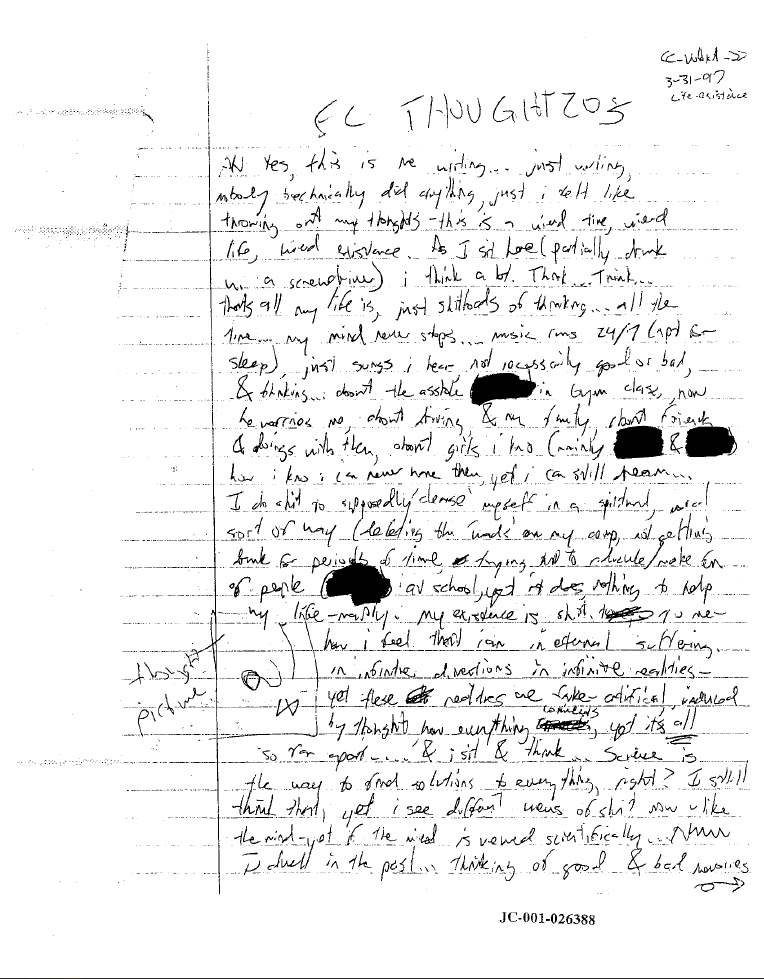
AH yes, this is me writing… just writing, nobody technically did anything, just i felt like throwing out my thoughts – this is a wierd time, wierd life, wierd existence. As i sit here (partially drunk w. a screwdriver) i think a lot. Think… Think… that’s all my life is, just shitloads of thinking… all the time… my mind never stops… music runs 24/7 (xpt for sleep), just songs i hear, not necessarily good or bad, & thinking… about the asshole [edited] in Gym class, how he worries me, about driving, & my family, about friends & doings with them, about girls i kno (mainly [edited] & [edited] how i kno i can never have them, yet i can still dream… I do shit to supposedly ‘cleanse’ myself in a spiritual, moral sort of way (deleting the ‘limits’ on my comp, not getting drunk for periods of time, trying not to ridicule/make fun of people [edited] at school, yet it does nothing to help my life – moraly. My existence is shit. To me – how i feel that i am in eternal suffering. in infinite directions in infinite realities – yet these [Dylan scribble] realities are fake- artificial, induced by thought, how everything connects, yet it’s all so far apart…. & i sit & think… Science is the way to find solutions to everything, right? I still think that, yet i see different views of shit now like the mind – yet if the mind is viewed scientifically… HMM I dwell in the past… thinking of good & bad movies
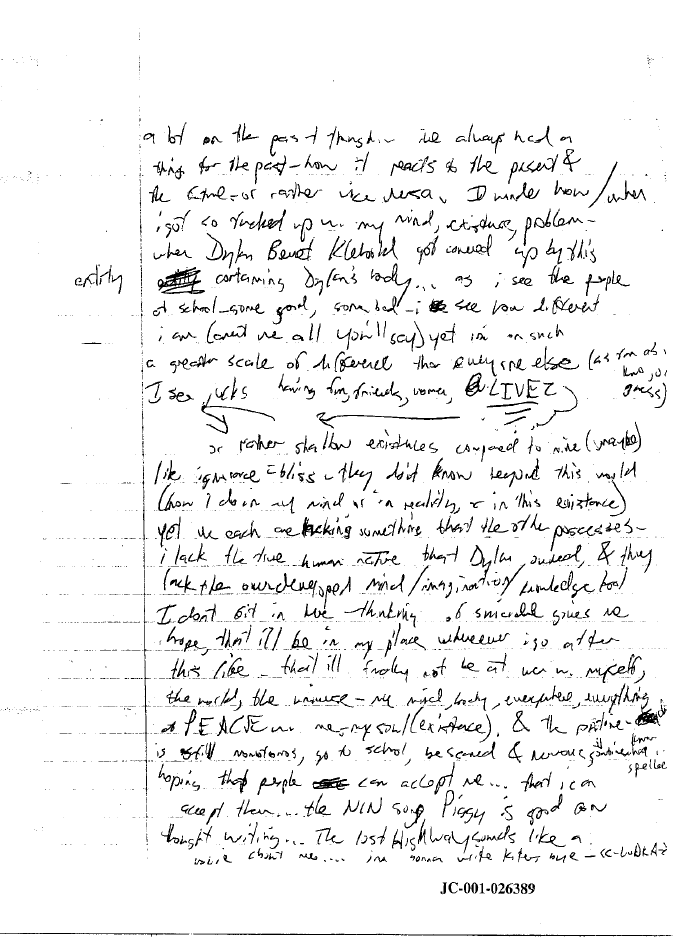
a lot on the past though… ive always had a thing for the past – how it reacts to the present & the future – or rather vice versa. I wonder how/when i got so fucked up… my mind, existence, problem – when Dylan Benet Klebold got covered up by this entity containing Dylan’s body… as i see the people at school – some good, some bad – I see how different i am (aren’t we all you’ll say) yet i’m on such a greater scale of difference (as far as I kno, or guess) I see jocks having fun, friends, woman, LIVEZ
[two drawn arrows pointing down to the text below]
or rather shallow existences compared to mine (maybe). Like ignorance = bliss – they don’t know this world (how I do in my mind or in reality, or in this existence) yet we each are lacking something that the other possesses — i lack the true human nature that Dylan owned, & they lack the overdeveloped mind/ imagination/ knowledge tool I don’t sit in here thinking of suicide gives me hope, that i’ll be in my place wherever I go after this life. that ill finally not be at war w. myself, the world, the universe – my mind, body, everywhere, everything at PEACE… me- my soul (existence). & the rotine – is still monotonous, go to school, be scared & nervous, somewhat hoping that people can accept me… that i can accept them… the NIN song Piggy is good for thought writing… The lost Highway sounds like a movie about me… im gonna write later, bye – <<-VoDkA->>
“AH yes, this is me writing… just writing… wierd life, wierd existence.”
The first lines, Klebold sounds lost inside his own thoughts aware of his isolation but unable to step outside of it. The repetition (“weird life, weird existence”) mirrors the looping, circular rhythm of “Piggy.” In the song, Reznor’s delivery has the same hypnotic, numbed tone: “Nothing can stop me now / ‘Cause I don’t care anymore.” Both express exhaustion rather than rage, a kind of emotional burnout where reflection replaces action. The act of writing, like Reznor’s singing, becomes a way to hold onto a fading sense of self.
“Think… Think… that’s all my life is, just shitloads of thinking… all the time…”
Here Klebold shows how his mind becomes a trap constant thinking that doesn’t lead to understanding. “Piggy”captures the same stuck feeling: its slow tempo and drumming sound like thoughts circling without release. The emotional paralysis Klebold describes (“my mind never stops”) matches the song’s repetitive structure. Both show what it feels like to be locked in self-awareness that only deepens despair.
“How I know I can never have them, yet I can still dream…”
This line exposes the ache of unfulfilled longing, connection imagined but never realized. In “Piggy,” that pain becomes resentment: the narrator sings to someone who has betrayed or abandoned him, but beneath the anger is heartbreak and loneliness. Reznor’s bitter delivery of “Hey pig, nothing’s turning out the way I planned” echoes Klebold’s quiet admission that hope and reality never meet. Both use emotional distance as a defense against rejection.
“My existence is shit… I feel that I am in eternal suffering.”
Klebold’s tone turns openly into despair here, describing himself as trapped in pain without purpose. “Piggy” carries this same emotional weight, but through resignation. The music drags, heavy and slow, as if the narrator has accepted suffering as permanent. Klebold’s description of “infinite directions in infinite realities” parallels the emotional disorientation of the song.
Feeling everywhere and nowhere at once. Both voices belong to someone drowning in their own mind, unable to reach stability.
“I see jocks having fun… I see how different I am… yet I’m on such a greater scale of difference.”
Here, Klebold expresses alienation in social terms.
He feels excluded from normal teenage life. The bitterness in “Piggy” is built from that same wound. Reznor’s “Pig” isn’t just another person; it represents the people and systems that seem oblivious to the narrator’s pain. For both, anger masks a longing for connection. The difference Klebold feels is both his pride and his curse, much like Reznor’s narrator who isolates himself as both victim and observer.
“The NIN song Piggy is good for thought writing…”
This line ties everything together it shows Klebold’s identification with Reznor’s world. He doesn’t just listen to “Piggy”; he uses it as a backdrop for self-reflection. The song becomes a mirror for his own mood.
Slow, numb, filled with resentment and exhaustion. What’s striking is that Klebold doesn’t mention anger here, only thought, suggesting that “Piggy” appealed to the reflective, not the violent, part of him. Both the song and the entry are about being lost in one’s own head, watching life happen to other people, and feeling powerless to join it.
Klebold’s entry and Reznor’s “Piggy” share the same emotional architecture: exhaustion, alienation, and quiet despair. Where “Mr. Self Destruct” externalized violence, “Piggy” turns inward resentment becomes numbness, and anger folds into reflection.
Heresy
He sewed his eyes shut because he is afraid to see
He tries to tell me what I put inside of me
He’s got the answers to ease my curiosity
He dreamed a god up and called it Christianity
God is dead and no one cares
If there is a hell I’ll see you there
He flexed his muscles to keep his flock of sheep in line
He made a virus that would kill off all the swine
His perfect kingdom of killing, suffering and pain
Demands devotion atrocities done in his name
God is dead and no one cares
If there is a hell I’ll see you there
Your God is dead and no one cares
If there is a hell I’ll see you there
Burning with your god in humility
Will you die for this?
God is dead and no one cares
If there is a hell I’ll see you there
(Your god is dead)
God is dead
(And no one cares)
And no one cares
(Drowning in his own hypocrisy)
If there is a hell I’ll see you there
The song
“Heresy” is one of the most openly angry and confrontational songs on The Downward Spiral. It attacks organized religion and the idea of a moral order that justifies human suffering. The repeated line “God is dead, and no one cares” expresses a deep loss of faith, not just in religion, but in meaning itself. The music is harsh and mechanical, filled with sharp beats and distorted vocals that sound like both rage and despair. Beneath the anger, the song suggests disappointment a sense that belief and hope have failed. This marks a turning point on the album: the narrator stops blaming himself and begins to lash out at the world, searching for someone or something to blame for his pain.
Dylan
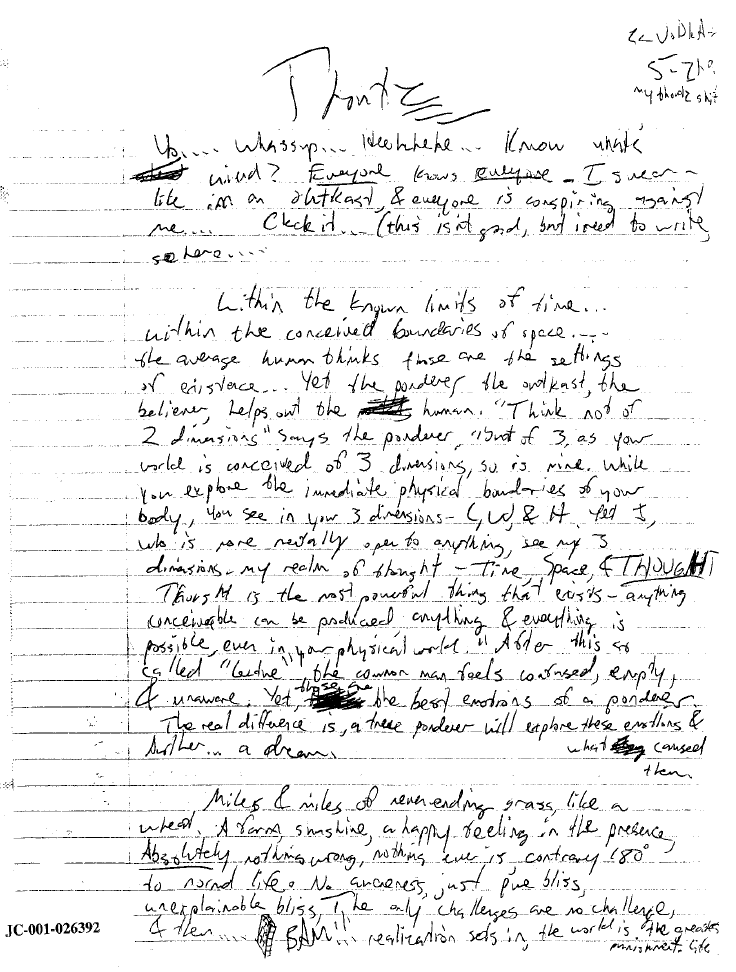
Transcript
<<-VoDkA->>
5-7-97
My thoutz shit
Thoutz
Yo…. whassup… heehehehe…Know what’s whiwierd? Everyone knows everyone. I swear, like im an outcast, & everyone is conspiring against me…. Check it… (this isn’t good, but i need to write, so here….)
Within the known limits of time… within the conceived boundaries of space… the average human thinks these are the settings of existence… Yet the ponderer, the outkast, the believer, helps out the human. “Think not of 2 dimensions” says the ponderer, “But of 3, as your world is conceived of 3 dimensions, so is mine. While you explore the immediate physical boundaries of your body, you see in your 3 dimensions – L, W, & H. Yet I, who is more mentally open to anything, see my 3 dimensions, my realm of thought – Time, Space, & THOUGHT. Thought is the most powerful thing that exists – anything conceivable can be produced, anything & everything is possible, even in your physical world.” After this so called “lecture” the common man feels confused, empty, & unaware. Yet, those are the best emotions of a ponderer. The real difference is, a true ponderer will explore these emotions & what caused them.
Another… a dream.
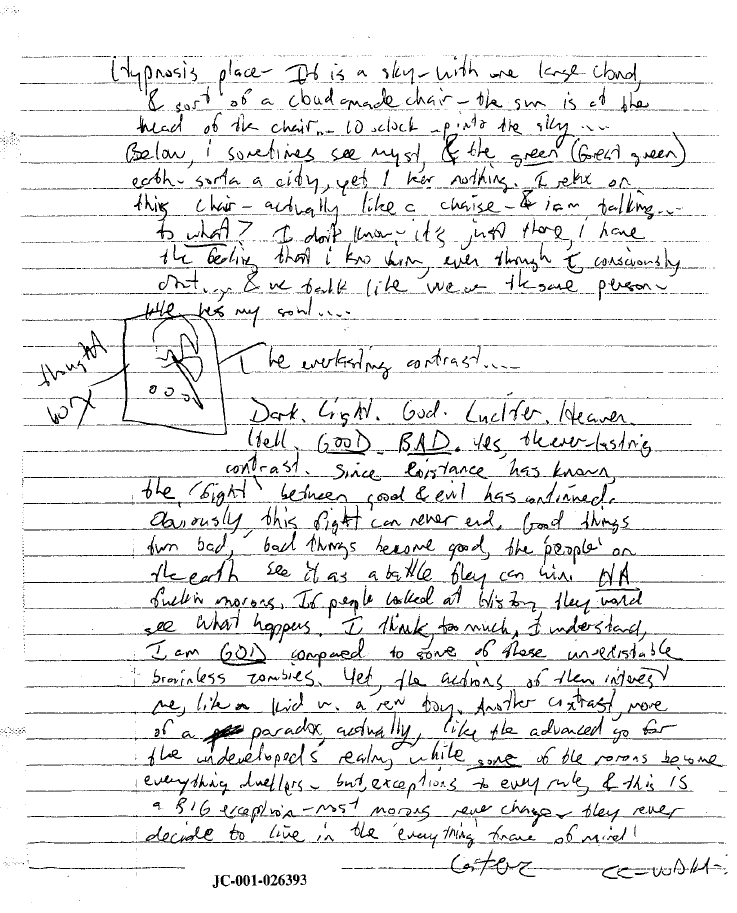
Miles & miles of never-ending grass, like a wheat. A farm, sunshine, a happy feeling in the presence, Absolutely nothing wrong, nothing ever is, contrary 180° to normal life. No awareness, just pure bliss, unexplainable bliss, The only challenges are no challenge, & then… [sketch of a wall] BAM!!! realization sets in, the world is the greatest punishment: life.
Hypnosis Place – It is a sky – with one large cloud, & sort of a cloud-made chair – the sun is at the head of the chair… 10 oclock up into the sky…. Below, i sometimes see myst, & the green (Great green) earth. sorta a city, yet I hear nothing. I relax on this chair – actually like a chaise – & i am talking… to what? I don’t know – it’s just there, i have the feeling that i kno him, even though I consciously dont… & we talk like we are the same person – like hes my soul….
[sketch of a ‘thought box’] The everlasting contrast….
Dark. Light. God. Lucifer. Heaven. Hell. GOOD. BAD. Yes, the ever-lasting contrast. Since existance has known, the ‘fight’ between good & evil has continued. Obviously, this fight can never end. Good things turn bad, bad things become good, the ‘people’ on the earth see it as a battle they can win. HA fuckin morons. If people looked at History, they would see what happens. I think, too much, I understand, I am GOD compared to some of these un-existable, brainless zombies. Yet, the actions of them interest me, like a kid w. a new toy. Another contrast, more of a paradox, actually, like the advanced go for the undevelopeds realm, while some of the morons become everything dwellers – but, exceptions to every rule, & this is a BIG exception – most morons never change – they never decide to live in the ‘everything’ frame of mind.
Laterz
<<-VoDkA->>
“Everyone knows everyone… I swear, like I’m an outcast, & everyone is conspiring against me.”
The entry starts with paranoia and alienation. Klebold’s feeling that the world is unified against him. In “Heresy,”Reznor’s narrator channels that same resentment outward. The song lashes out at external systems such as religion, morality, conformity that seem to trap or exclude him. Both express a sense of being separate from and superior to the masses, but that superiority only deepens isolation.
Klebold builds himself up as a “ponderer” someone who sees deeper truths than ordinary people.
“The ponderer, the outkast, the believer… ‘Think not of 2 dimensions… but of 3.’”
In “Heresy,” that sense of moral and intellectual clarity turns to anger: “He tries to tell me what I put inside of me / He’s got the answers to ease my curiosity.” Both reject external authority and celebrate independent thought, but beneath the confidence is bitterness. Reznor’s sneer at religion mirrors Klebold’s frustration with “brainless zombies” who accept simple versions of good and evil.
“The world is the greatest punishment: life.”
This line is the emotional core of the entry, and it could almost be a lyric on The Downward Spiral. It reflects the same nihilistic tone as Reznor’s “God is dead, and no one cares.” For both, life itself feels like a curse. This loss of meaning is what “Heresy” is built around: the collapse of belief in any moral or divine structure that could justify suffering.
“Dark. Light. God. Lucifer. Heaven. Hell. GOOD. BAD… Obviously, this fight can never end.”
Here, Klebold explicitly names the binary that defines “Heresy.” The song’s fury comes from the same rejection of moral opposites. The idea that good and evil, heaven and hell, are arbitrary constructs. Klebold mocks people who still believe in the “fight” between them, calling them “morons.” In “Heresy,” Reznor’s lyrics perform the same act of rebellion, stripping away divine meaning and replacing it with human rage: “Your god is dead, and no one cares / If there is a hell, I’ll see you there.” Both use blasphemy not just as shock, but as liberation, a way to claim ownership over their own pain.
“I am GOD compared to some of these… brainless zombies.”
This is where Klebold’s tone fully aligns with the aggression in “Heresy.” Feeling powerless in daily life, he asserts control through thought making himself godlike in comparison to others. In Reznor’s song, the narrator does the same: tearing down God is also a way of declaring himself independent from divine rules. In both, the confidence feels unstable, a reaction to feeling powerless, rather than true empowerment.

In “Heresy,” Reznor rails against God, organized religion, and the imposition of moral codes.
Klebold’s comment: “You’re fucking little christian godly little whores” shows the same pattern. It’s an explicit act of moral rebellion, framing religious devotion as a provocation.
The song externalizes inner rage at moral authority; similarly, Klebold projects his frustration onto his victims, conflating social rejection, jealousy, and resentment of moral expectations.
“Heresy” reflects a broader existential disillusionment, the narrator feels abandoned by God and betrayed by morality.
Klebold eventually focused his indiscriminate shooting spree on Schnurr. He fired his shotgun at the girl, who then lay on the ground pleading for God as the shooter walked away. When he heard her crying for help, however, he returned.
“God?” Klebold asked her. “Do you believe in God?” According to Wyant, Valeen Schnurr hesitated for a brief moment before responding: “Yes. I believe in God.” Klebold asked her why, to which Schnurr plainly replied: “Because I believe. And my parents brought me up that way.” – witness account
In “Heresy,” Reznor repeatedly attacks God and organized religion, with lines like:
“Your God is dead, and no one cares.”
Klebold’s question to Schnurr — “God? Do you believe in God?” — shows a real-world enactment of the same blasphemous, confrontational stance. Like the song, it expresses anger and confusion toward faith, not just abstractly, but as a lived, intense moral confrontation.
The song frames God and morality as external structures that impose guilt or suffering.
Both the song and this real-world action reflect a collision between human violence and religious belief. In “Heresy,”the narrator expresses rage at God and moral codes; in Klebold’s interaction with Schnurr, we see the manifestation of that rage. It reinforces the album’s central idea that despair and alienation can turn outward when one feels abandoned by divine or moral structures.
Together, Klebold’s journal entry and his real-world statements show two sides of the same struggle explored in “Heresy.” In the journal, he reflects inwardly on moral conflict, the endless battle between good and evil, and his alienation from others. In contrast, the Schnurr account and basement tape quote show how that frustration and anger could be projected outward. Both reveal a mind grappling with authority, morality, and meaning.
March of the pigs
Step right up, march, push
Crawl right up on your knees
Please, greed, feed (no time to hesitate)
I want a little bit
I want a piece of it
I think he’s losing it
I want to watch it come down
Don’t like the look of it
Don’t like the taste of it
Don’t like the smell of it
I want to watch it come down
All the pigs are all lined up
I give you all that you want
Take the skin and peel it back
Now doesn’t it make you feel better?
Shove it up inside, surprise, lies
Stains like the blood on your teeth
Bite, chew, suck (away the tender parts)
I want to break it up
I want to smash it up
I want to fuck it up
I want to watch it come down
Maybe afraid of it
Let’s discredit it
Let’s pick away at it
I want to watch it come down
All the pigs are all lined up
I give you all that you want
Take the skin and peel it back
Now doesn’t that make you feel better?
The pigs have won tonight
Now they can all sleep soundly
And everything is all right
“March of the Pigs” is a burst of chaos. Loud, fast, and aggressive. The song attacks hypocrisy, greed, and the ugliness of human behavior, portraying people as animals driven by consumption and self-interest. The abrupt tempo changes and distorted sounds make it feel unstable and violent, like it could collapse at any moment. Beneath the rage, though, there’s a sense of exhaustion and disgust not just with others, but with the self. The line “doesn’t it make you feel better?” captures the hollow satisfaction that comes from anger and destruction, fitting the album’s continuing descent into self-loathing and loss of control
Dylan
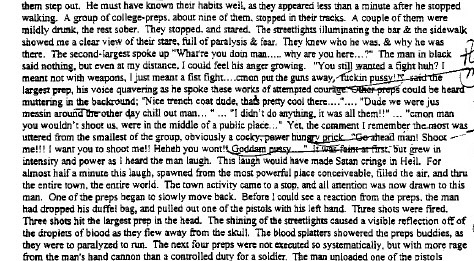
Transcript:
“They knew who he was, & why he was there. The second-largest spoke up “What’re you doin man… why’re you here…” The man in black said nothing, but even at my distance, I could feel his anger growing. “You still wanted a fight huh? I meant not with weapons, I just meant a fist fight—come on put the guns away, fuckin pussy!” he said to the largest prep, his voice quavering as he spoke those words of attempted courage. The preps could be heard muttering in the background; “Nice trench coat dude, that’s pretty cool there…” “Dude we were just messin around the other day chill out man…” “I didn’t do anything, it was all them!” “C’mon man you wouldn’t shoot us, we’re in the middle of a public place.” Yet, the comment I remember the most was uttered from the smallest of the group, obviously a cocky, power-hungry prick— “Go ahead man! Shoot me!!! I want you to shoot me!! Heheh you won’t! Goddamn pussy!” But grew in intensity and power as I heard the man laugh. This laugh would have made Satan cringe in Hell. For hatred as immense as this laugh, spawned from the most powerful place conceivable, filled the air, and thru the entire town, no one moved. The town activity came to a stop, and all attention was now drawn to this man. One of the preps began to slowly move back. Before I could see a reaction from the preps, the man had dropped his drift bag, and pulled out one of the pistols with his left hand. Three shots were fired. The first struck the largest prep in the head. The shining of the streetlights caused a visible reflection of the droplets of blood as they flew away from the skull. The blood splatters showered the prep’s buddies, as they screamed to run. The next four preps were not executed so systematically, but with more rage than man’s hand cannon than a controlled duty for a soldier. The man unloaded one of the pistols…”
“March of the Pigs” captures the sound of pure chaos, anger, disgust, and a desire to tear down a world that feels fake and suffocating. The track’s frantic tempo changes and violent bursts of sound mimic the loss of control that comes when frustration turns into fury. In Klebold’s short story, the same emotions runs underneath the scene: a character, humiliated and mocked by a group of “preps,” suddenly explodes into violence. The story’s detailed description of blood, rage, and the man’s “laugh that would have made Satan cringe in Hell” echoes the song’s portrayal of dehumanization and collapse.
Like the “pigs” in Reznor’s lyrics, the “preps” in Klebold’s story are stripped of humanity, portrayed as shallow, mocking, and undeserving of empathy. They become symbols of everything false and hypocritical in the world, faceless extensions of a system the narrator despises. This act of dehumanizing others mirrors the song’s violent rhythm and sneering lyrics, which turn disgust into a kind of liberation. Both the song and the story explore what happens when alienation hardens into hatred. When a sense of difference becomes a justification for destruction.
Together, the song and the story mark a shift from internal suffering to external rage. The sadness of “Piggy” and the moral questioning of “Heresy” give way here to raw hostility and control. It’s the point in The Downward Spiral where despair stops turning inward and instead lashes out at the world, dehumanizing others in an attempt to escape one’s own powerlessness. That collapse into violence chaotic, furious, and momentarily freeing sets the stage for the deeper psychological breakdown that follows on the rest of the album.
Closer
You let me violate you
You let me desecrate you
You let me penetrate you
You let me complicate you
I broke apart my insides
(Help me) I’ve got no soul to sell
(Help me) the only thing that works for me
Help me get away from myself
I wanna fuck you like an animal
I wanna feel you from the inside
I wanna fuck you like an animal
My whole existence is flawed
You get me closer to God
You can have my isolation
You can have the hate that it brings
You can have my absence of faith
You can have my everything
you tear down my reason
(Help me) it’s your sex I can smell
(Help me) you make me perfect
Help me become somebody else
(Chorus repeats)
Through every forest
Above the trees
Within my stomach
Scraped off my knees
I drink the honey
Inside your hive
You are the reason
I stay alive
After the chaos of “March of the Pigs,” “Closer” dives inward away from public rage and into private obsession. The song is infamous for its explicit chorus (“I wanna fuck you like an animal”), but beneath the shock is something far more vulnerable. Reznor uses sex as a metaphor for self-destruction, power, and the need to feel something real. The pounding rhythm and mechanical beat suggest a body driven by impulse rather than emotion.
Lines like “You get me closer to God” turn that desire into something almost spiritual. The song isn’t about lust in a simple sense; it’s about trying to find connection through ruin. Replacing love or faith with physical intensity.
“Closer” marks another turning point in The Downward Spiral.
Dylan
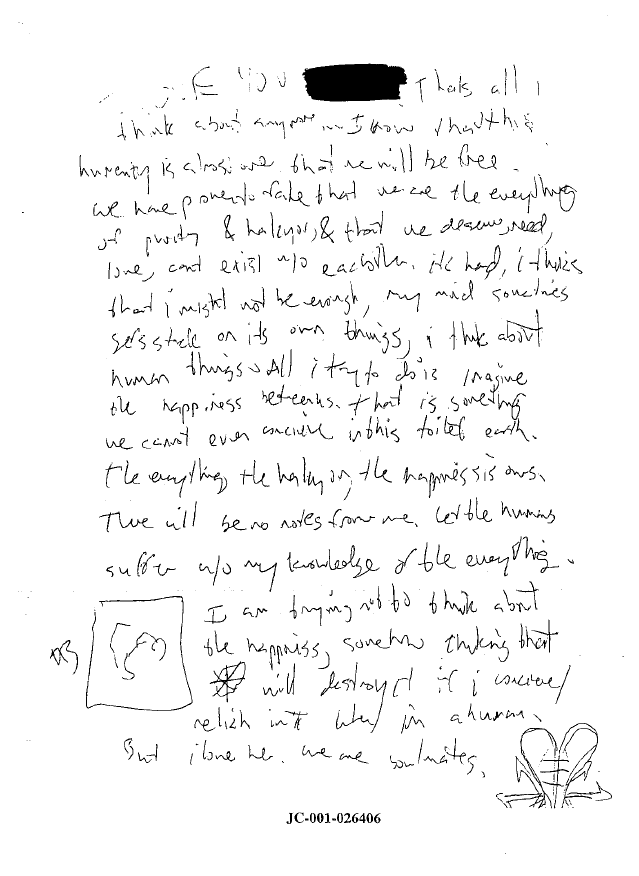
Transcript:
I LOVE YOU
[edited] Thats all I think about anymore… I know that this humanity is almost done. that we will be free. We have proven to fate that we are the everything of purity & halcyon, & that we deserve, need, love, cant exist w/o each other. its bad i think that i might not be enough, my mind sometimes gets stuck on its own things, i think about human things. All i try to do is imagine the happiness between us.
that is something we cannot even concieve in the toilet earth. The everything, the halcyon, the happiness is ours. There will be no notes from me. Let the humans suffer w/o my knowledge of the everything.I am trying not to think about the happiness, somehow thinking that will destroy it if i concieve/relish in it when I’m a human. But i love her. we are soulmates.
In “Closer,” Trent Reznor explores the search for meaning in the most intimate, physical space: desire. Beneath the sexual provocation of “I wanna f*** you like an animal” lies a confession of emotional starvation. Lines like “You get me closer to [something higher]” reveal how love, lust, and longing can merge into a transcendent(think the 3-5th realm Dylan often referenced.) experience, a desperate attempt to feel anything that cuts through numbness. The more intense the connection, the more it feels like a bridge to something beyond ordinary life.
Klebold’s journal reflects a similar craving for transcendence through love. “I love you… we are soulmates,” he writes, describing a bond so pure it exists beyond the “toilet earth.” Like Reznor, he transforms intimacy into a spiritual, almost cosmic event. He imagines his relationship as a force that will liberate him from “humanity,” from a world he perceives as corrupt and meaningless. Yet in that purity, there is delusion: love becomes detached from reality, existing only as fantasy. A perfect state he can never attain.
Both “Closer” and Klebold’s writing reveal the same paradox: the longing to be loved so completely that it erases isolation, alongside the fear that such love cannot exist in the real world. For Reznor, that longing becomes a self-destructive ritual, expressed through obsession, intensity, and sometimes degradation (“I want to f*** you like an animal / I want to feel you from the inside”). For Klebold, it evolves into an exclusionary ideology. The belief that he and his love stand above other “humans.” In both cases, the need for connection transforms into alienation, turning the pursuit of transcendence into separation from the world.
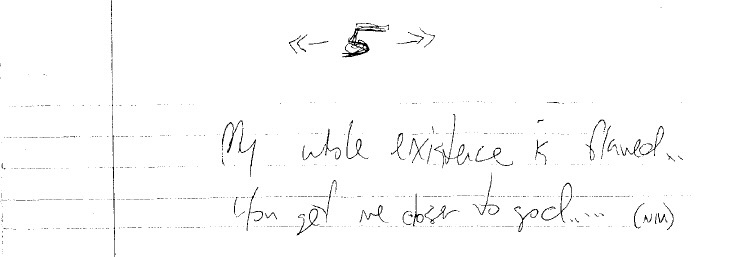
You get me closer to god….. (nin) (excerpt from Dylan’s journal.)
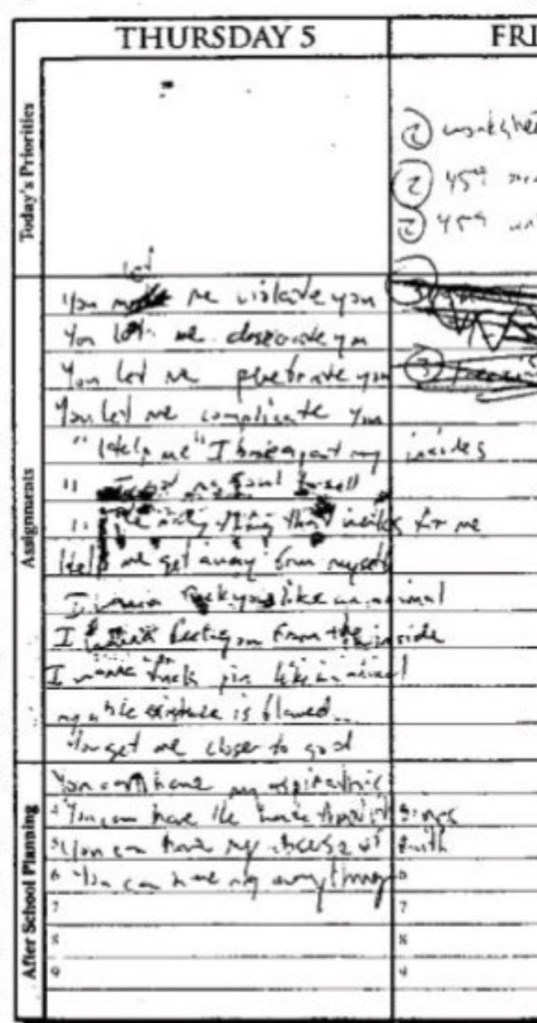
The ruiner
You had all of them on your side
Didn’t you, didn’t you?
You believed in all your lies
Didn’t you, didn’t you?
The Ruiner’s got a lot to prove
He’s got nothing to lose and now he made you believe
The Ruiner is your only friend
And he’s the living end to the cattle he deceives
Raping of the innocent
You know the Ruiner ruins everything he sees
Now the only pure thing left
In my fucking world is wearing your disease
How’d you get so big?
How’d you get so strong?
How’d it get so hard?
How’d it get so long?
You had to give them all a sign
Didn’t you, didn’t you?
You had to covet what was mine
Didn’t you, didn’t you?
The ruiner’s a collector
He’s an infecter, serving his shit to his flies
Maybe there will come a day
When those that you keep blind will suddenly realize
Maybe it’s a part of me
You took it to a place I hoped it would never go
And maybe that fucked me up much more than you’ll ever know
(Chorus repeats)
And what you gave to me?
My perfect ring of scars
You know I can see
What you really are
You didn’t hurt me
Nothing can hurt me
You didn’t hurt me
Nothing can stop me now x5
“The Ruiner” turns betrayal into a kind of machinery. Reznor’s voice snarls over grinding synths and broken beats, the music itself sounding infected by anger. “The ruiner is here, he’s tearing me apart” begins as an accusation but slowly folds inward, revealing that the ruiner might be the self. The alternating lines “You can’t leave” and “I can’t leave” trap the song in a loop of power and dependence, where rage becomes a form of attachment. It’s not just about hating someone else. it’s about being unable to escape the damage you’ve made of yourself.
Dylan
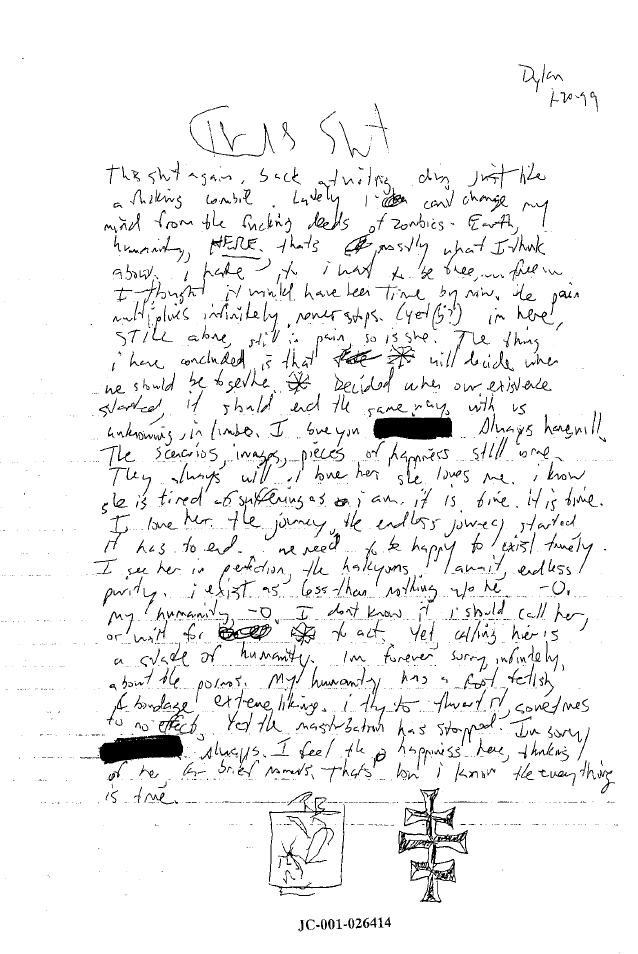
Transcript:
This Shit
This shit again. back at writing doing just like a fucking zombie. Lately I cant change my mind from the fucking deeds of zombies. Earth, humanity, HERE. thats mostly what I think about. I hate it. I want to be free…. free… I thought it would have been time by now. the pain multiplies infinitely. never stops. (yet(¿?) im here, STILL alone, still in pain. so is she. The thing i have concluded is that fate
will decide when we should be together.
Decided when our existence started, it should end the same way, with us unknowing, in limbo. I love you
[edited]. Always have, will. The scenarios, images, pieces of happiness still come. They always will. I love her. she loves me. i know she is tired of suffering as i am. it is time. it is time. I love her. the journey, the endless journey, started it has to end. we need to be happy to exist timely. I see her in perfection, the halcyons. love it, endless purity. i exist as a less than nothing w/o her -O.
my humanity, -O. I dont know if I should call her, or wait for f
to act. Yet, calling her is a state of humanity. Im forever sorry, infinitely, about the pornos. My humanity has a foot fetish, & bondage exteme liking. i try to thwart it, sometimes to no effect, Yet the masturbation has stopped. I’m sorry
[edited] Always. I feel the happiness here, thinking of her, for brief moments. Thats how i know the everything is true.
In “The Ruiner,” Trent Reznor turns bitterness into a weapon. The song seethes with accusation “The ruiner is here, he’s tearing me apart” but the real conflict is internal. The music’s grinding pulse and distorted vocals capture the collapse between victim and aggressor, self and enemy. Dylan Klebold’s journal echoes that same implosion. “This shit again,” he writes, “back at writing doing just like a fucking zombie.” His “zombies” are the people around him, the peers and ordinary humans he sees as lifeless, shallow, and corrupt. Like Reznor’s narrator, he directs his pain outward, blaming a dehumanized world for his loneliness. Yet the hatred loops back on itself, he despises “humanity,” but also hates that he’s still part of it. Even his sexual guilt (“I’m forever sorry… my humanity has a foot fetish & bondage extreme liking”) shows the same self-punishing cycle of shame and repression that Reznor channels into the song’s fury. Both “The Ruiner” and Klebold’s writing reveal a mind trapped between superiority and self-loathing, desperate to destroy whatever reminds it of its own weakness.
“The Ruiner” and Klebold’s journal collapse the boundary between hating the world and hating the self. What begins as resentment toward others, the “zombies,” the betrayers becomes an admission of inner decay.
The becoming
I beat my machine
It’s a part of me
It’s inside of me
I’m stuck in this dream
It’s changing me
I am becoming
The me that you know, he had some second thoughts
He’s covered with scabs
He is broken and sore
The me that you know
He doesn’t come around much
That part of me
Isn’t here anymore
All pain disappears
It’s the nature of
Of my circuitry
Drowns out all I hear
No escape from this
My new consciousness
The me that you know
He used to have feelings
But the blood has stopped pumping and he is left to decay
The me that you know is now made up of wires
And even when i’m right with you i’m so far away
I can try to get away
But I’ve strapped myself in
I can try to scratch away
The sound in my ears
I can see it killing away
All of my bad parts
I don’t want to listen
But it’s all too clear
Hiding
Backwards inside of me
I feel… so unafraid
Annie, hold a little tighter
I might just slip away
It won’t give up, it wants me dead
Goddamn this noise inside my head x7
In “The Becoming,” Reznor turns inward, charting the moment when pain no longer just hurts. It transforms. “It won’t give up, it wants me dead,” he mutters, as layers of mechanical noise overwhelm his voice. The song captures the feeling of being consumed by one’s own defenses, becoming something less human in order to survive. Beneath the chaos is grief, a mourning for the self that’s been replaced.
Dylan
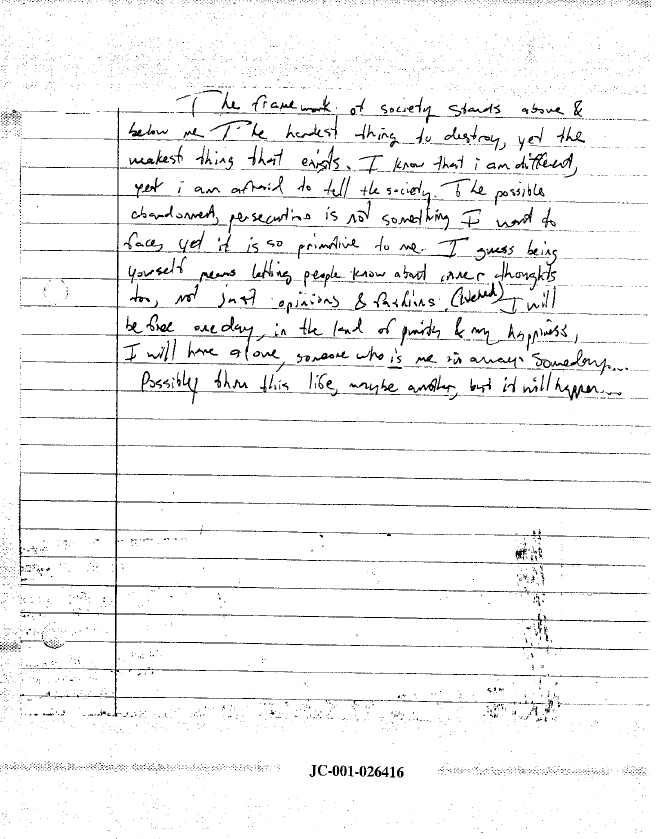
Transcript:
The framework of society stands above & below me. The hardest thing to destroy, yet the weakest thing that exists. I know that i am different, yet i am afraid to tell the society. The possible abandonment, persecution is not something I want to face, yet it is so primitive to me. I guess being yourself means letting people know about inner thoughts too, not just opinions & fashions. (Heheh) I will be free one day, in the land of purity & my happiness, I will have a love, someone who is me in a way. Someday… Possibly thru this life, maybe another, but it will happen…
In “The Becoming,” Reznor stages a confrontation between the human self and the machine it’s turning into. The song pulses with a kind of mechanical dread.
“I beat my machine, it’s part of me,” he screams, as if recognizing that survival now depends on becoming what he hates. The transformation is both a defense and a surrender: the only way to stop feeling is to stop being human. Klebold’s journal captures a similar fracture. “The framework of society stands above & below me,” he writes, describing a world he no longer fits into but can’t escape. His desire to be “free… in the land of purity and happiness” echoes Reznor’s desperate push toward reinvention. A fantasy born from alienation. Both voices dream of breaking through the limits of flesh and conformity, but the escape they imagine comes at the cost of their own identity. What begins as rebellion against the system ends as self-erasure.
I do not want this
I’m losing ground
Well, you know how this world can beat you down
And I’m made of clay
I fear I’m the only one who thinks this way
I’m always falling down the same hill
Bamboo puncturing the skin
And nothing comes bleeding out of me
Just like a waterfall I’m drowning in
Two feet below the surface
I can still make out your wavy face
And if I could just reach you
Maybe I could leave this place
I do not want thisX3
And don’t you tell me how I feel
Don’t you tell me how I feel
Don’t you tell me how I feel
You don’t know just how I feel
I stay inside my bed
I have lived so many lives all in my head
And don’t tell me that you care
There really isn’t anything now, is there?
You would know, wouldn’t you?
You extend your hand to those who suffer
To those who know what it really feels like
To those who’ve had a taste
Like that means something
And oh, so sick I am
And maybe I don’t have a choice
And maybe that is all I have
And maybe this is a cry for help
I do not want thisX3
(Chorus repeats)
I wanna know everything
I wanna be everywhere
I wanna fuck everyone in the world
I wanna do something that matters x3
In “I Do Not Want This,” Reznor turns inward again, caught between self-loathing and the desperate need to be seen. “I want to know everything, I want to be everywhere,” he pleads, before collapsing into “Don’t you tell me how I feel.” It’s the sound of a mind tearing itself apart, torn between wanting control and wanting to disappear. The song marks yet another turning point in The Downward Spiral. A moment where the narrator can still feel shame, still crave understanding, even as he tries to destroy the part of himself that feels.
Dylan
Transcript:
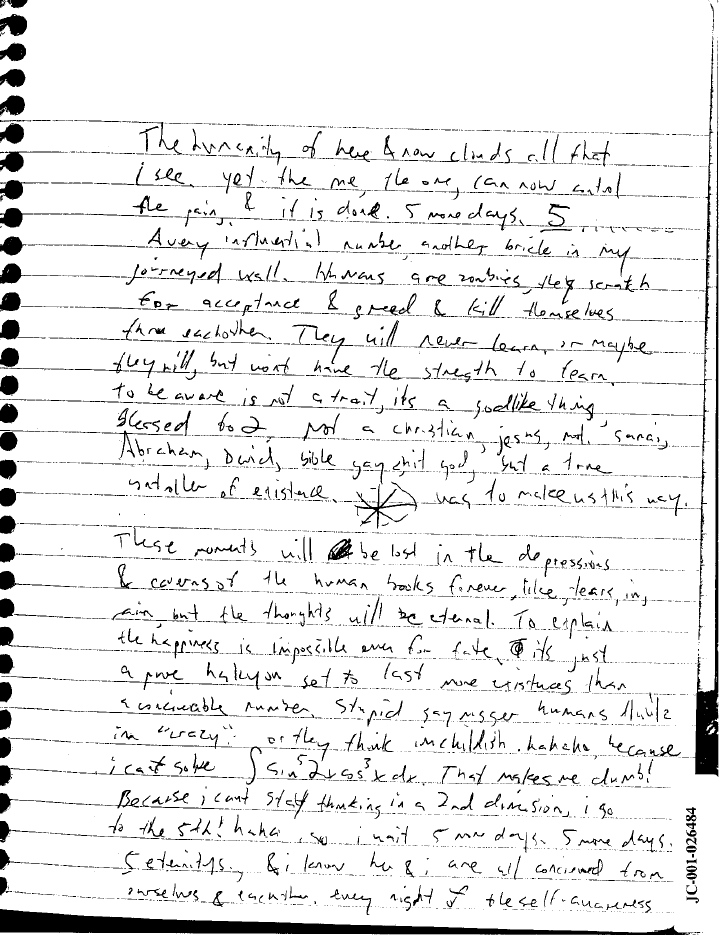
The humanity of here & now clouds all that I see. yet the me, the one, can now control the pain, & it is done. 5 more days. 5……. A very influential number, another brick in my journeyed wall. Humans are zombies, they search for acceptance & greed & kill themselves thru each other. They will never learn, or maybe they will, but wont have the stregth to learn. to be aware is not a trait, its a godlike thing, Blessed God. Not a christian, jesus, mt. sanai, Abraham, David, bible gay shit god, but a true controller of existence. has to make us this way.
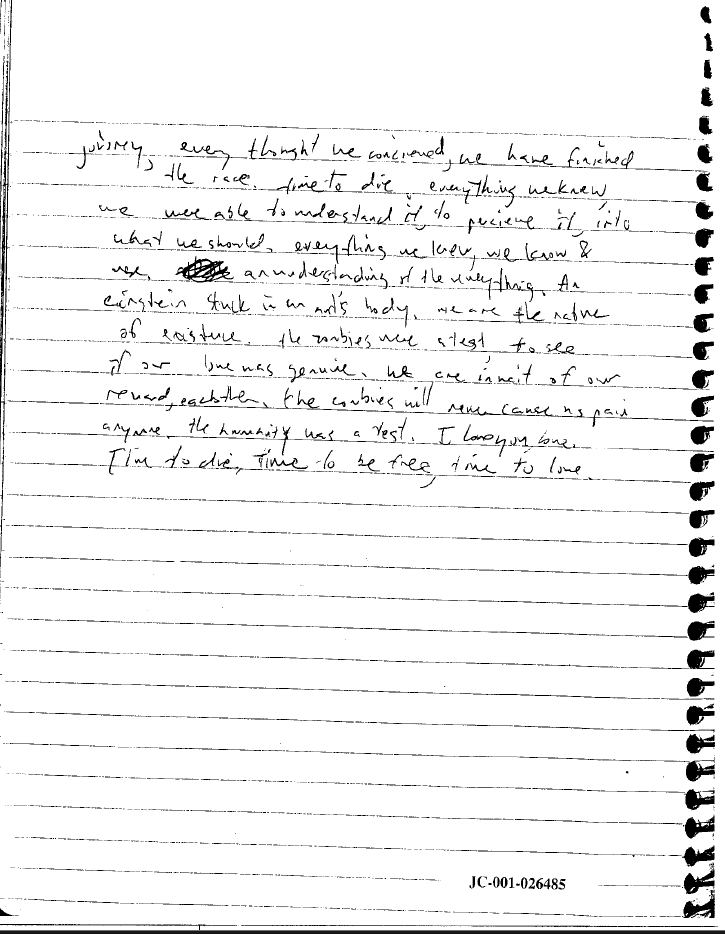
These moments will be lost in the depressions & caverns of the human books forever, like, tears, in, pain, but the thoughts will be eternal. To explain the happiness is impossible ever for fate. its just a pure halcyon set to last more existences than a conceivable number. stupid gay nigger humans think im “crazy”. or they think im childish. hahaha. because i cant solve S sin52xss3xdx. That makes me dumb! Because i cant stay thinking in a 2nd dimension, i go to the 5th! haha. so i wait 5 more days. 5 more days. 5 eternitys. & i know he & i are concieved from ourselves & each other. every night of the self-awareness journey, every thought we concieved, we have finished the race. time to die. everything we knew, we were able to understand it, to percieve it, into what we should, everything we knew, we know & use. an understanding of the everything. An einstein stuck in an ant’s body. we are the nature of existence. the zombies were a test to see if our love was genuine. we are in wait of our reward, each other. the zombies will never cause us pain anymore. the humanity was a test. I love you, love. Time to die, time to be free, time to love.
In “I Do Not Want This,” Reznor captures the frustration of being trapped within oneself, yearning for understanding yet unable to escape the limitations of the human mind. Klebold’s journal reflects a similar state of alienation and godlike self-perception. He writes, “Humans are zombies… to be aware is not a trait, it’s a godlike thing… we are in wait of our reward, each other. The zombies will never cause us pain anymore. The humanity was a test. I love you, love. Time to die, time to be free, time to love” Here, the offensive language and slurs used by Klebold highlight his profound detachment from peers and society, framing humanity itself as a corrupted force from which he must separate.
Ultimately, both Reznor and Klebold depict the same psychological tension: the desire to escape human limitation and suffering, even at the cost of separating from the world and oneself, showing how isolation and self-judgment can transform longing into obsession.
Big man with a gun
I am a big man
(Yes I am)
And I have a big gun
Got me a big old dick and I
I like to have fun
Held against your forehead
I’ll make you suck it
Maybe I’ll put a hole in your head
You know just for the fuck of it
I can reduce you if I want
I can devour
I’m hard as fucking steel and I’ve got the power
I’m every inch a man and I’ll show you somehow
Me and my fucking gun
Nothing can stop me now
Shoot shoot shoot shoot shoot
I’m going to come all over you x3
Me and my fucking gun x7
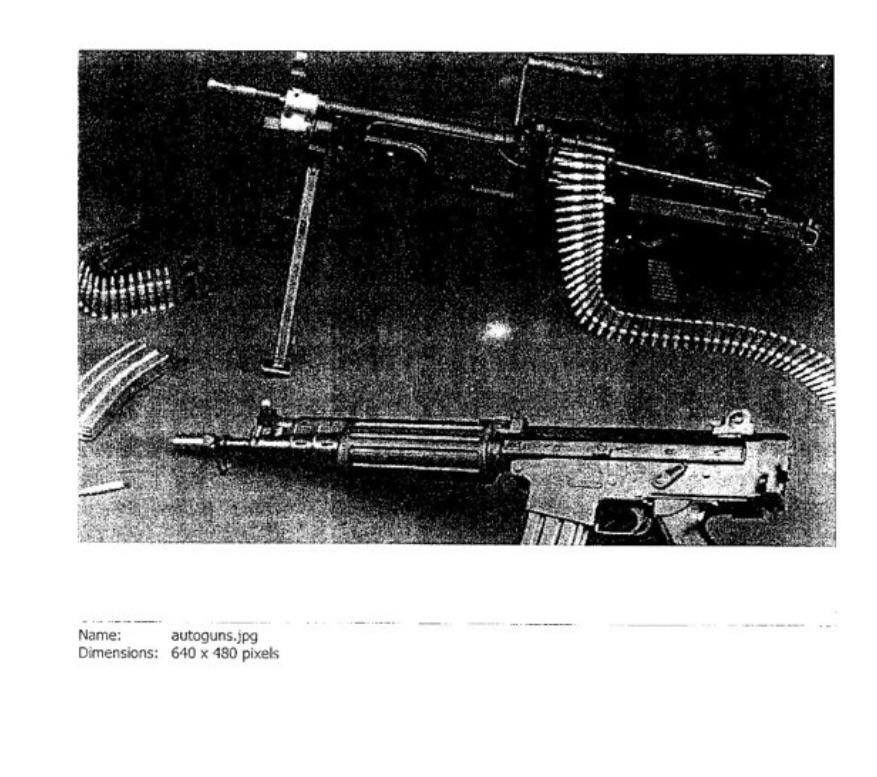
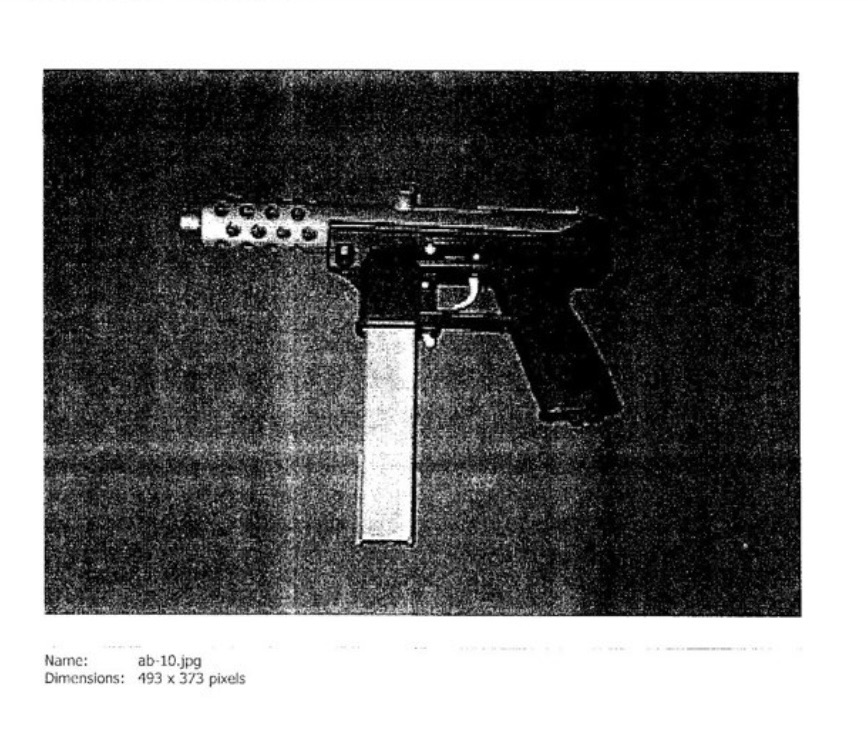
In “Big Man With a Gun,” Reznor shifts to an aggressive, almost theatrical portrayal of domination and sexualized power. The song exaggerates the persona of someone who asserts control through intimidation: the narrator boasts of violence and authority, blending fantasy and reality. Musically, the track is brief but jarring. Unlike the introspective despair of earlier songs, this track externalizes rage and insecurity, showing how obsession with control can manifest as aggression and performative masculinity.
Dylan
Transcript:
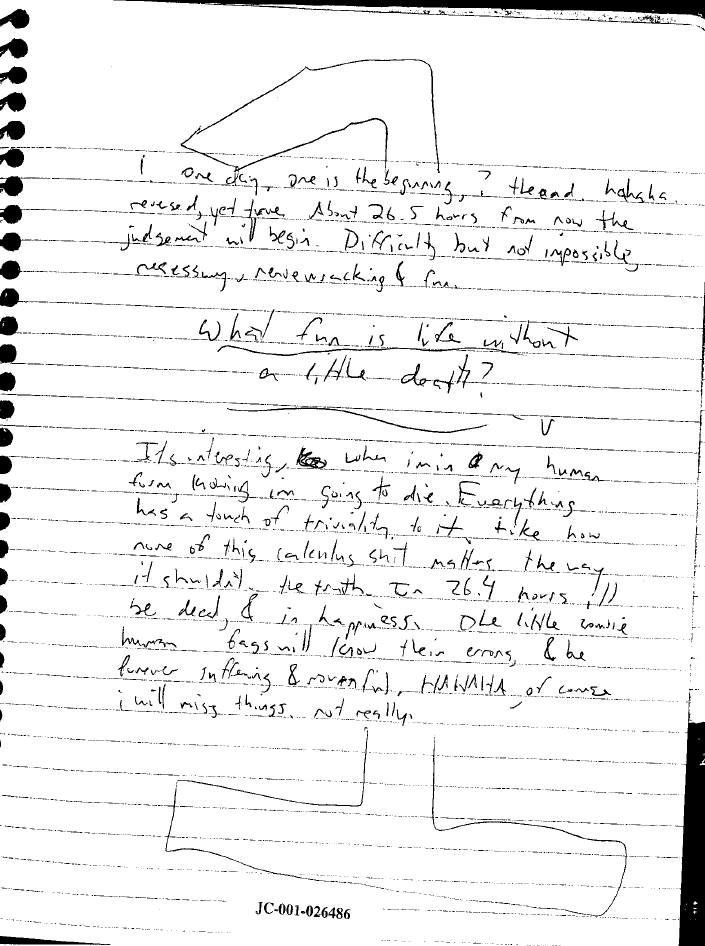
1 One day. one is the beginning? the end. hahaha. reversed, yet true. About 26.5 hours from now the judgement will begin. Difficult, but not impossible, necessary, nervewracking & fun.
What fun is life without
a little death?Its interesting, when im in my human form, knowing im going to die. Everything has a touch of triviality to it. like how none of this calculus shit matters. the way it shuldn’t. the truth. In 26.4 hours ill be dead, & in happiness. The little zombie human fags will know their errors, & be forever suffering & mournful, HAHAHA, of course i will miss things. not really.
In “Big Man With a Gun,” Reznor pushes masculine aggression to its breaking point. The voice is grotesque, sneering, intoxicated with control. “I am so big,” he spits, parodying the swagger of dominance. But behind the posturing is emptiness; the louder the performance, the more hollow it sounds. Violence becomes a desperate act of self-definition. Klebold’s journal captures the same collapse of meaning. His tone mirrors Reznor’s character mocking, detached, reveling in superiority. Both voices speak from the same psychological wound: humiliation twisted into power, vulnerability hidden behind rage.
In the end, both reveal how domination and violence are born from the same place
The fear of being powerless and how the fantasy of control always collapses back into emptiness.

A warm place
No lyrics, instrumental.
After the violent release of “Big Man With a Gun,” “A Warm Place” feels like the album’s one breath of mercy. There are no words just slow, fragile tones that seem to hold the ruins of everything that came before. The melody drifts between comfort and sorrow, suggesting a momentary escape from pain that can’t last. It’s not happiness, but the faint memory of it.
Dylan
Transcript:
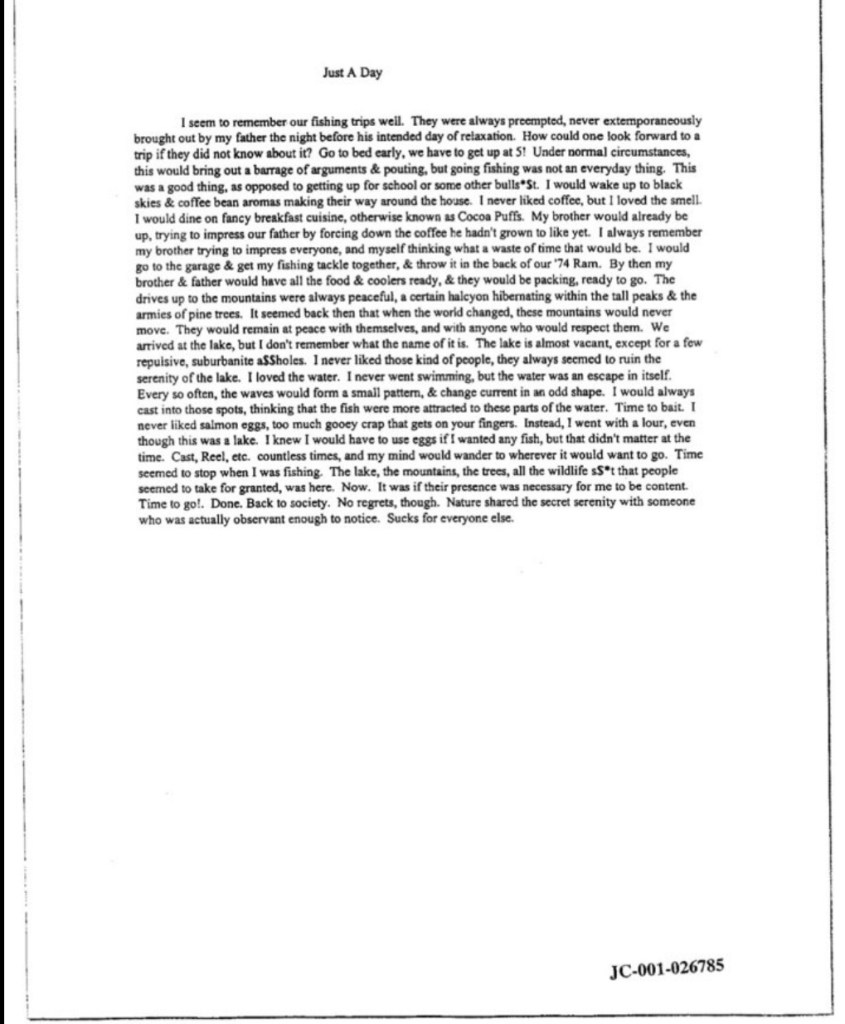
Just A Day
I seem to remember our fishing trips well. They were always prompted, never extemporaneously brought out by my father the night before his intended day of relaxation. How could one look forward to a trip if they did not know about it? Go to bed early, we have to get up at 5! Under normal circumstances, this would bring out a barrage of arguments & pouting, but going fishing was not an everyday thing. This was a good thing, as opposed to getting up for school or some other bullsh*t. I would wake up to black skies & coffee bean aromas making their way around the house. I never liked coffee, but I loved the smell. I would dine on fancy breakfast cuisine, otherwise known as Cocoa Puffs. My brother would already be up, trying to impress our father by forcing down the coffee he hadn’t grown to like yet. I always remember my brother trying to impress everyone, and myself thinking what a waste of time that would be. I would go to the garage & get my fishing tackle together, & throw it in the back of our ’74 Ram. By then my brother & father would have all the food & coolers ready, & they would be packing, ready to go. The drives up to the mountains were always peaceful, a certain halcyon hibernating within the tall peaks & the armies of pine trees. It seemed back then that when the world changed, these mountains would never move. They would remain at peace with themselves, and with anyone who would respect them. We arrived at the lake, but I don’t remember what the name of it is. The lake is almost sacred, except for a few repulsive, submarine a$$holes. I never liked those kind of people, they always seemed to ruin the serenity of the lake. I loved the water. I never went swimming, but the water was an escape in itself. Every so often, the waves would form a small pattern, & change current in an odd shape. I would always cast into those spots, thinking the fish were more attracted to these parts of the water. Time to bait. I never liked salmon eggs, too much gooey crap that gets on your fingers. Instead, I went with a lurer, even though this was a lake. I knew I would have to use eggs if I wanted any fish, but that didn’t matter at the time. Cast, Reel, etc. countless times, and my mind would wander to wherever it would want to go. Time seemed to stop when I was fishing. The lake, the mountains, the trees, all the wildlife s**t that people seemed to take for granted, was here. Now. It was if their presence was necessary for me to be content. Time to go!. Done. Back to society. No regrets, though. Nature shared the secret serenity with someone who was actually observant enough to notice. Sucks for everyone else.
In “A Warm Place,” Reznor offers a rare moment of stillness amid the chaos of The Downward Spiral. The track drifts without words, a brief return to something human before everything collapses again. Klebold’s short essay “Just a Day” captures a similar quiet. Writing about a fishing trip with his father, he lingers on the small details: the smell of coffee, the stillness of the lake, the sense that “the world changed, but the mountains would never move.” Like Reznor’s instrumental, the piece is contemplative and nostalgic, searching for permanence in a world that constantly slips away.
The calm only makes the return to reality more painful.
Eraser
Need you
Dream you
Find you
Taste you
Fuck you
Use you
Scar you
Break you
Lose me
Hate me
Smash me
Erase me
Kill me x8
In “Eraser,” Reznor turns desire into a death wish. The song begins with the rhythm of obsession l “Need you, dream you, find you, taste you” But as it builds, the language shifts from possession to self-violence: “Lose me, hate me, smash me, erase me.” The repetition of “kill me” at the end collapses everything. love, lust, self, and other into one final scream. The more he reaches outward, the more he disappears. The music mirrors that unraveling: distortion swells until the voice is buried under noise. What began as craving becomes annihilation. “Eraser” is the moment where connection and destruction merge, where wanting someone becomes a way of erasing oneself.
Dylan
Transcript:
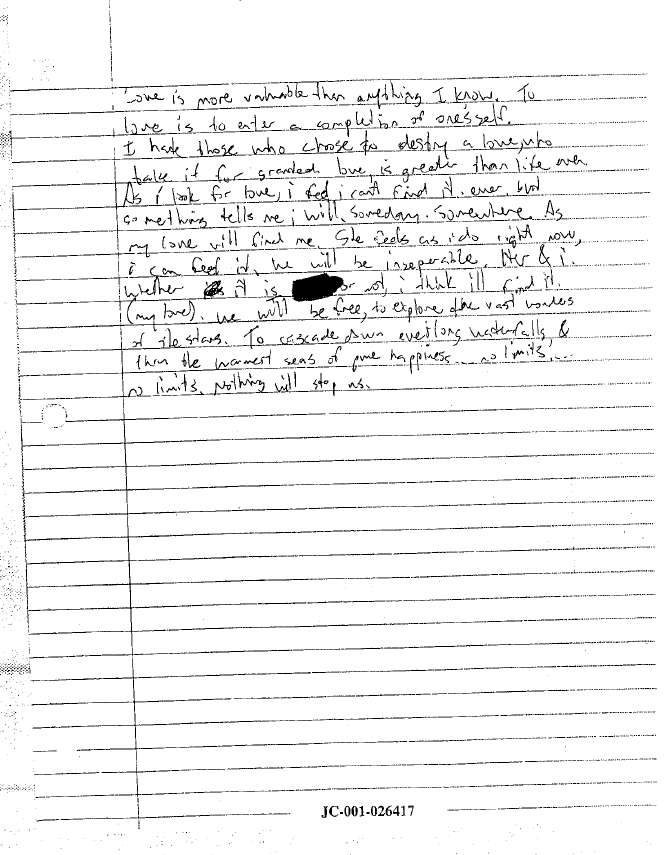
Love is more valuable than anything I know. To love is to enter a completion of one’s self. I hate those who choose to destroy a love, who take it for granted. love is greater than life even. As i look for love, i feel i can’t find it. ever. but something tells me i will. Someday. Somewhere. As my love will find me. She feels as i do right now, i can feel it. we will be inseperable. Her & i. Whether it is [edited] or not, i think ill find it. (my love). we will be free, to explore the vast wonders of the stars. To cascade down everlong waterfalls, & thru the warmest seas of pure happiness… no limits… no limits. Nothing will stop us.
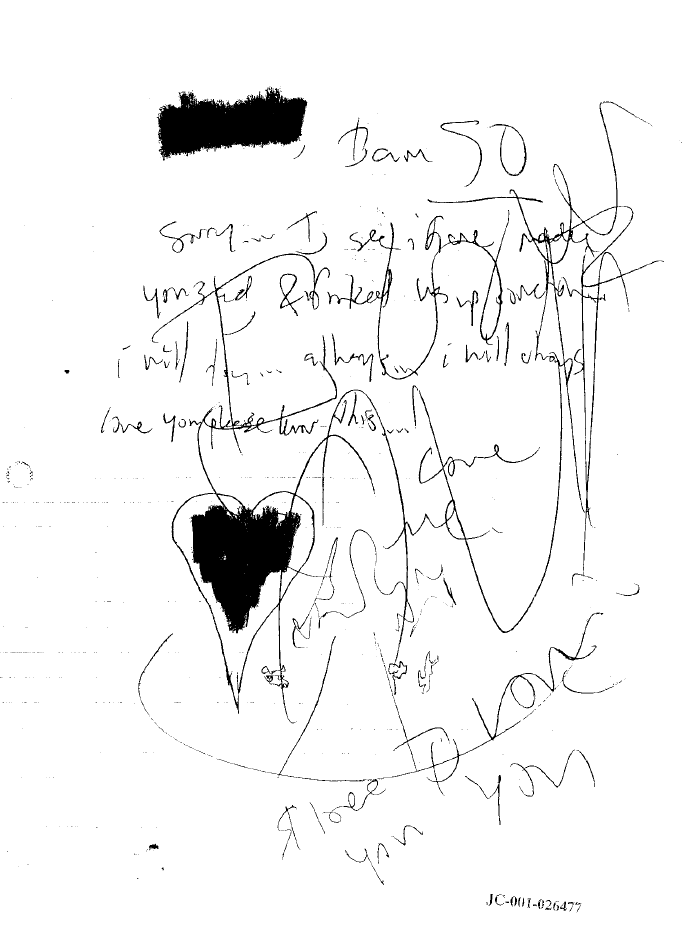
Transcript:
[scrawled over everything are the words “I LOVE YOU”] [edited], I am SO Sorry… I see i have made you sad & fucked us up somehow. i will try… always… i will always love you please know this…. love me I love you I LOVE YOU
In “Eraser,” Reznor collapses the line between desire and self-destruction. Each word “Need you / Dream you / Find you / Taste you / Fuck you / Use you / Scar you / Break you” l pulls him deeper into obsession until it breaks down into self-hatred: “Lose me / Hate me / Smash me / Erase me.” The violence turns inward: love becomes the weapon and the wound. He doesn’t want to kill someone else; he wants to be erased, to stop being the person who keeps ruining everything he touches.
Klebold’s journals echo that same emotional rhythm. “I am SO sorry… I see I have made you sad & fucked us up somehow,” he writes, filling the page with apologies and “I LOVE YOU” scrawled over itself. The guilt is the same, the belief that love and destruction are inseparable, that hurting the one you love is proof of how deeply you need them. Both Reznor and Klebold circle around the same collapse: when love becomes the only thing that gives life meaning, losing it feels like losing the right to exist.
Klebold’s journals echo the same urge for release through love. “Love is more valuable than anything I know… we will be free, to explore the vast wonders of the stars,” he writes. On the surface, it sounds romantic but “free” here means free from life, from the “humanity” he saw as corrupt and unfixable.
Both “Eraser” and the journal reveal a longing so absolute that it can’t survive the real world. The more they try to love, the more they destroy themselves in the process. Love becomes confession, punishment, and erasure all at once.
Reptile
She spreads herself wide open to let the insects in
She leaves a trail of honey to show me where she’s been
She has the blood of reptile just underneath her skin
Seeds from a thousand others drip down from within
Oh, my beautiful liar
Oh, my precious whore
My disease, my infection
I am so impure
Give it
Devils speak of the way in which she’ll manifest
Angels bleed from the tainted touch of my caress
Need to contaminate, to alleviate this loneliness
I now know the depths I reach are limitless
Oh my beautiful liar
Oh my precious whore
My disease, my infection
I am so impure
Oh, my beautiful liar
Oh, my precious whore
My disease, my infection
I am so impure
Oh, my beautiful liar
Oh, my precious whore
My disease, my infection
I am so impure
In “Reptile,” Reznor turns obsession into disgust. The song opens with a mechanical, grinding pulse, setting a sterile, oppressive tone as he watches intimacy decay: “She spreads herself wide open to let the insects in.” The language collapses love and revulsion into one, exposing the corrosive nature of desire when mixed with mistrust and contempt. Musically, the track mirrors this tension: harsh, crawling rhythms underpin fragile vocals, reflecting the clash of attraction and repulsion. “Reptile” captures a moment where desire becomes self-destructive, a cycle of craving, disgust, and control that can’t be broken.
Dylan
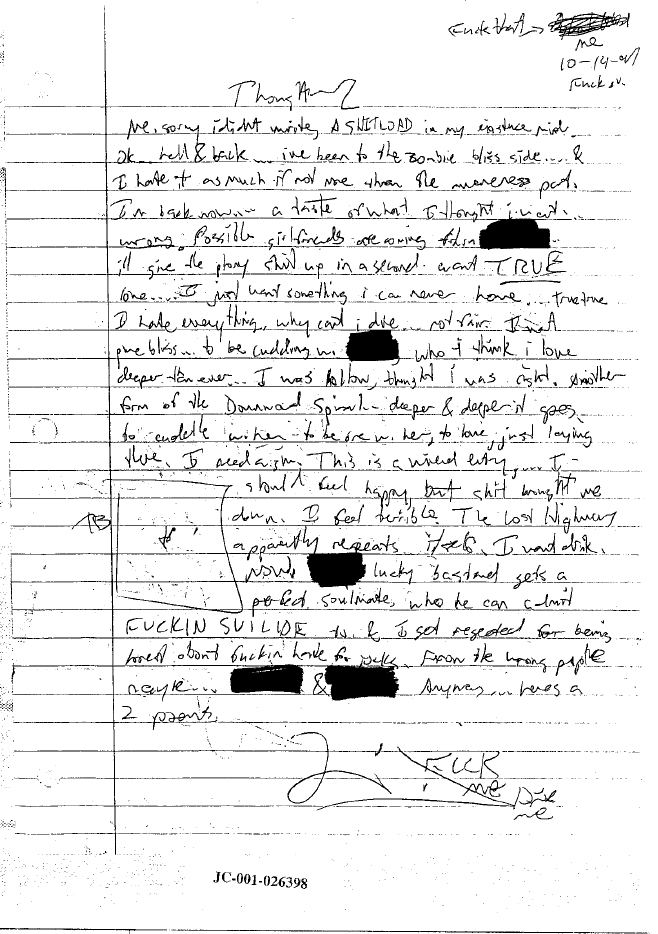
Transcript:
Thoughtz
Me. sorry I didn’t write, A SHITLOAD in my existence mist. Ok… hell & back… ive been to the zombie bliss side… & I hate it as much if not more than the awareness part. I’m back now…. a taste of what I thought I want… wrong. Possible girlfriends are coming then [edited].. I’ll give the phony shit up in a second. want TRUE love…. I just want something i can never have…. true true I hate everything. why can’t I die… not fair. I want pure bliss… to be cuddling w.
[edited], who i think i love deeper than ever… I was hollow, thought I was right. Another form of the Downward Spiral… deeper & deeper it goes. to cuddle w. her, to be one w. her, to love; just laying there. I need a gun. This is a wierd entry… I should feel happy, but shit brought me down. I feel terrible. [Sketch of a “thought box” labeled ‘TB’] The Lost Highway apparently repeats itself. I want drink. now.
[edited] lucky bastard gets a perfect soulmate, who he can admit FUCKIN SUICIDE to & I get rejected for being honest about fuckin hate for jocks. From the wrong people maybe…
[edited] &
[edited].. Anyway… heres a 2 poems…
2 FUCK
me
Die
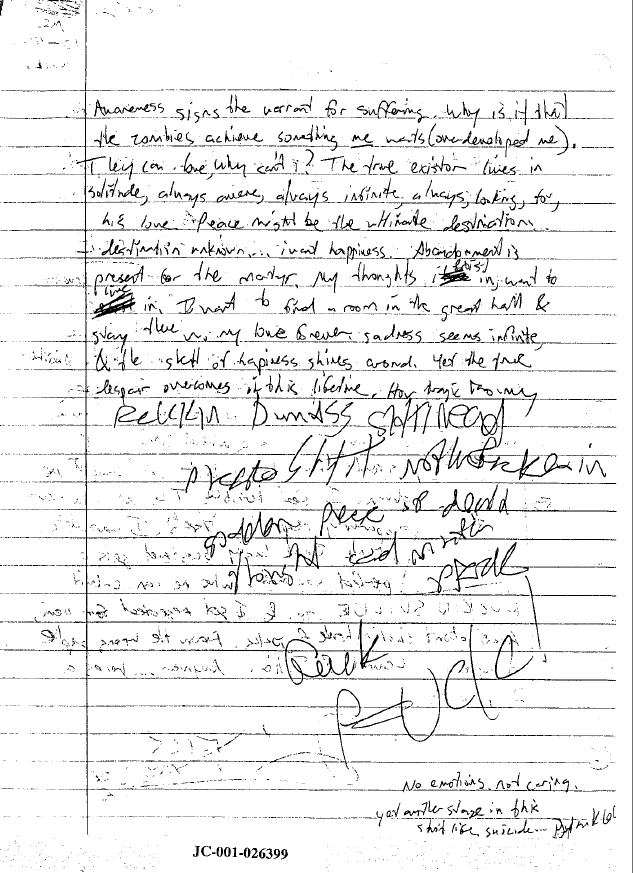
meAwareness signs the warrant for suffering. why is it that the zombies achieve something me wants (overdeveloped me). They can love, why can’t i? The true existence lives in solitude, always aware, always infinite, always, looking, for, his love. Peace might be the ultimate destination… destination unknown… i want happiness. Abandonment is present for the martyr. my thoughts exist in, want to exist live in. I want to find a room in the great hall & stay there w. my love forever. sadness seems infinite, & the shell of happiness shines around. Yet the true despair overcomes it this lifetime. How tragic too my
FUCKIN DUMASS SHITHEAD
I HATE SHIT motherfuckin
goddam piece of death
thought and nothin
FUCK
FUCK
FUCK!
No emotions. not caring.
yet another stage in this
shit life. suicide… Dylan Klebold
In “Reptile,” Reznor’s obsession finally curdles into disgust. The song’s pulse is slow and mechanical, the sound of something rotting from the inside. “She spreads herself wide open to let the insects in” turns intimacy into infection. He calls her “My beautiful liar / My precious whore,” caught between desire and loathing. Every touch feels both sacred and sick. This isn’t about one person anymore; it’s about the decay of connection itself.
Klebold’s “Thoughtz” journal spirals through the same emotional terrain. He writes, “I just want something I can never have… true true I hate everything.” Like Reznor, he swings between yearning and rage, love and nihilism. His line “Another form of the Downward Spiral… deeper & deeper it goes” could be a direct echo of Reznor’s world, the sense that every attempt to feel leads further into self-destruction. As the entry unravels, his tone shifts from melancholy to violent outburst: “FUCKIN DUMASS SHITHEAD… I HATE SHIT motherfuckin goddam piece of death.” That eruption mirrors the sonic climax of “Reptile,” where the music itself starts to break apart, as if the structure can’t contain the emotion anymore.
Both voices come from the same emotional logic: the belief that love and meaning exist, but only just out of reach and that the failure to reach them must mean there’s something rotten inside yourself.
In each case, the longing for closeness becomes proof of alienation, and the failure to attain it intensifies the disgust and despair. The song and the journal remind us that sometimes the most painful part of wanting love is realizing how far it can push a person from themselves.
The Downward Spiral
He couldn’t believe how easy it was
He put the gun into his face
Bang!
(So much blood from such a tiny little hole)
Problems do have solutions, you know
A lifetime of fucking things up fixed in one determined flash
Everything’s blue
Everything’s blue in this world
The deepest shade of mushroom blue
All fuzzy
Spilling out of my head
“The Downward Spiral” serves as the album’s self-reflective apex, a literal and metaphorical representation of collapse. Musically, it’s jagged and suffocating. Lyrically, it’s a manifesto of self-destruction: the narrator traces the cycle of obsession, failure, and despair that has consumed him throughout the album. There is no resolution, only repetition.
The track encapsulates the album’s central theme: that the combination of longing, self-hatred, and failed connection inevitably leads back to the same abyss.
Dylan
Transcript:
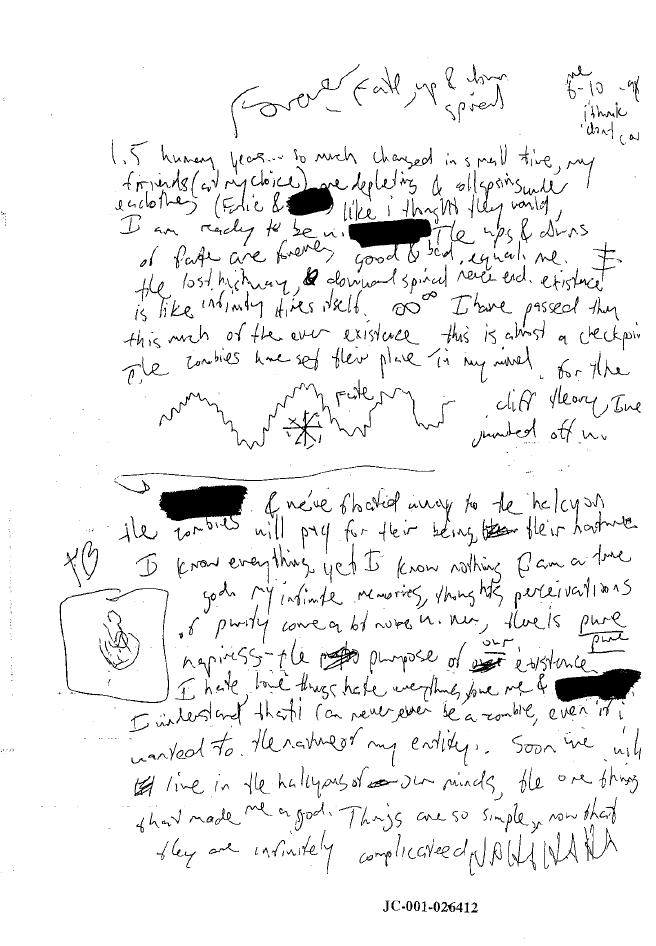
Forever, Fate, up & down spiral 1.5 human years…. so much changed in small time, my friends (at my choice) are Sketch of fate by Dylan Klebolddepleting & collapsing under each other (Eric & [edited]) like i thought they would. I am ready to be w. [edited]. The ups & downs of fate are forever, good & bad, equal. me. [tri-tier cross] the lost highway, & downward spiral never end. existence is like infinity times itself. ∞ ∞ I have passed thru this much of the ever existence. this is almost a checkpoint. The zombies have set their place in my mind. for the cliff theory, Ive jumped off w. [arrow down to] [edited] & we’ve floated away to the halcyon. the zombies will pay for their being, their nature. I know everything, yet I know nothing. I am a true god. my infinite memories, thoughts, Dylan Klebold’s thought boxperceivations of purity come a lot more w. her, there is pure pure hapiness — the pupo purpose of our our existence. I hate, love things. hate everything, love me & [edited]. I understand that i can never ever be a zombie, even if i wanted to. the nature of my entity.. Soon we will live in the halcyons of our minds, the one thing that made me a god. Things are so simple, now that they are infinitely complicated. HAHAHAHA
In this journal entry, Klebold mirrors the title track of The Downward Spiral almost explicitly, not just in imagery but in philosophy. He references both “the lost highway”, the David Lynch film that haunted him and “the downward spiral,” merging them into a single idea of endless collapse and renewal. “Existence is like infinity times itself,” he writes, describing his own life as a loop of destruction and transcendence. For both Reznor and Klebold, the spiral marks a descent into meaninglessness, yet the way out differs. In The Downward Spiral, Reznor’s narrator disintegrates and loses all sense of self. For Klebold, the same descent becomes transformation. He turns his alienation into revelation, declaring “I am a true god.”
By merging Lynch’s surreal fatalism with Reznor’s nihilism, Klebold reframes despair as a gateway to transcendence. His spiral doesn’t end in death, but in what he sees as release. An escape from the “zombie” world into a private eternity.
Hurt
I hurt myself today
To see if I still feel
I focus on the pain
The only thing that’s real
The needle tears a hole
The old familiar sting
Try to kill it all away
But I remember everything
What have I become?
My sweetest friend
Everyone I know
Goes away in the end
You could have it all
My empire of dirt
I will let you down
I will make you hurt
I wear this crown of shit
Upon my liar’s chair
Full of broken thoughts
I cannot repair
Beneath the stains of time
The feelings disappear
You are someone else
I am still right here
What have I become?
My sweetest friend
Everyone I know
Goes away in the end
And you could have it all
My empire of dirt
I will let you down
I will make you hurt
If I could start again
A million miles away
I would keep myself
I would find a way
Dylan
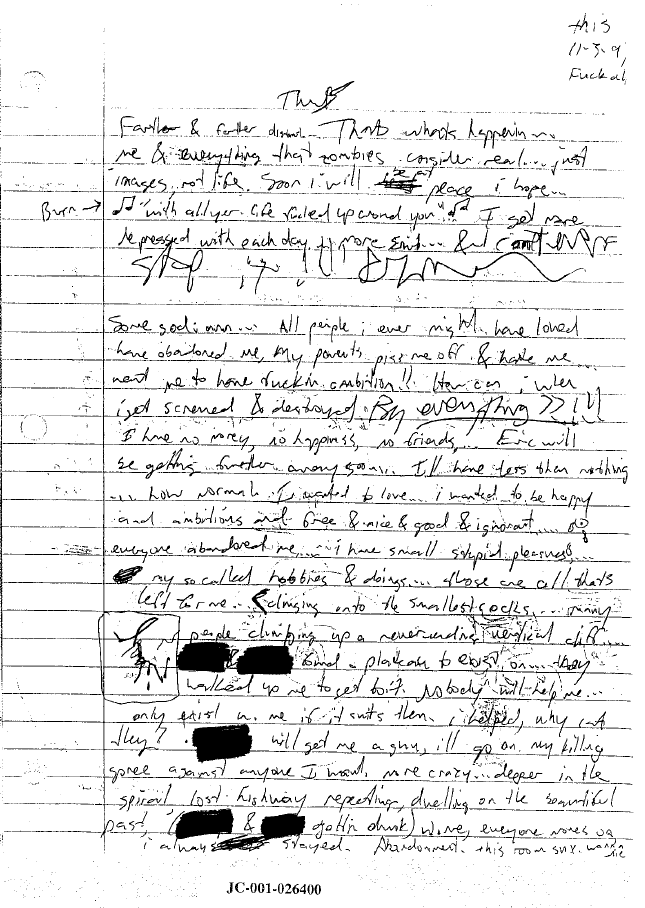
Transcript:
ThoughtS
Farther & farther distant… That’s what’s happening. me & everything that zombies consider real… just images, not life. Soon I will be at peace I hope..
Burn –> ♫ “with all yer life fucked up around you”. ♫ I get more depressed with each day… more shit…. & I CAN’T EVER STOP IT!!!! [illegible scrawl]
Some god i am… All people i ever might have loved have abandoned me, my parents piss me off & hate me… want me to have fuckin ambition!! How can i when i get screwed & destroyed By everything??!!!! I have no money, no happiness, no friends… Eric will be getting farther away soon… I’ll have less than nothing… how normal. I wanted to love… i wanted to be happy and ambitious and free & nice & good & ignorant…. everyone abandoned me…. i have small stupid pleasures,… my so called hobbies & doings…. those are all thats left for me. < clinging onto the smallest rocks… many people climbing up a never-ending vertical cliff….
[edited]&
[edited] found a plateau to exist on….they walked up me to get to it. Nobody will help me… only exist w. me if it suits them. i helped, why cant they?
[edited] will get me a gun, ill go on my killing spree against anyone I want. more crazy…deeper in the spiral, lost highway repeating, dwelling on the beautiful past, (
[edited] &
[edited] gettin drunk) w. me, everyone moves up i always stayed. Abandonment. this room sux. wanna die.
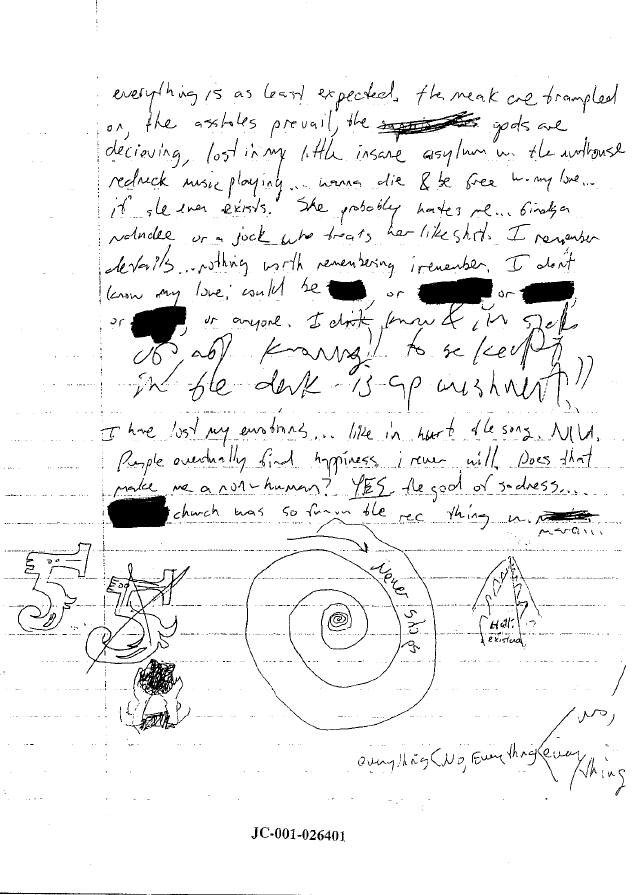
everything is as least expected. The meak are trampled on, the assholes prevail, the gods are decieving, lost in my little insane asylum w. the outhouse redneck music playing… wanna die & be free w. my love… if she even exists. She probably hates me… finds a [illegible] or a jock who treats her like shit. I remember details… nothing worth remembering i remember. I don’t know my love: could be
[edited], or
[edited], or
[edited], or
[edited], or anyone. I don’t know & im sick of not KNOWING!! to be kept in the dark is a punishment!!!
I have lost my emotions… like in hurt the song. NIN. People eventually find happiness. i never will. Does that make me a non-human? YES. the god of sadness…
[edited] church was so fun…. the rec thing w. marc…
anything < no, everything < NO!
everything
Klebold’s “Thoughts” entry echoes “Hurt” almost line for line in its emotional tone. Both are written from the bottom of the spiral. The point where anger burns out and only desolation remains. When he writes, “Farther & farther distant… That’s what’s happening. me & everything that zombies consider real… just images, not life,” it parallels Reznor’s opening admission: “I hurt myself today, to see if I still feel.” Both articulate alienation so deep that the self begins to disappear, and both blur the line between pain and existence.
What’s striking is that Klebold explicitly references “Hurt” (“like in hurt the song. NIN.”). That awareness ties his despair directly to Reznor’s work not just thematically, but personally. Yet where “Hurt” suggests a fragile moment of self-recognition (“I wear this crown of shit upon my liar’s chair”), Klebold remains locked in blame and abandonment: “Everyone abandoned me… I have lost my emotions.”
In Reznor’s world, pain becomes the final proof of being, the faint sign that something human still remains. In Klebold’s, pain becomes proof of non-humanity: “Does that make me a non-human? YES. the god of sadness.” That reversal shows how he took the album’s existential despair and reinterpreted it through his own delusions of separation and superiority.
Ultimately, both “Hurt” and the journal recognize isolation and regret, but where Reznor’s narrator ends in fragile awareness, Klebold turns it into self-mythology.
Reznor’s narrator still hopes for redemption; Klebold replaces that hope with finality. In “Hurt,” pain becomes a way to stay connected to life. In Klebold’s version, it becomes proof that life is already over. The song ends with a fragile human voice; the journal, with a declaration of detachment. One reaches for healing, the other for annihilation, both standing on the same edge, staring into the same void, but seeing two different endings.
Next page is conclusion/wrap up as well as pictures of Dylan referring the downward spiral.
 Echoes in the Columbine Archive
Leave a comment