This post is a deep dive into Eric Harris’ connection to the Marine Corps. What he wrote about it, how often he mentioned it, what can be confirmed through other sources/witnesses, and what happened when he explored enlistment in real life. I’ll start off by introducing the marines and processes overall before we touch on Eric’s stuff. I’ll also look at the possible inspirations behind his interest, based on the media he consumed and the environment he grew up in.
The US Marine Corps
The United States Marine Corps is one of the four main branches of the U.S. Armed Forces. It functions as a rapid-response, highly mobile force trained for combat on land, at sea, and from the air. During the 1990s, the Marines were especially known for their involvement in conflict zones such as the Gulf War, Somalia, and peacekeeping operations in various regions.
Marines were (and still are) known for being one of the most physically and mentally demanding branches.
Mottos and Core Identity
A few mottos and slogans define Marine culture:
“Semper Fidelis” Latin for Always Faithful.
“The Few. The Proud. The Marines.” the major recruitment slogan throughout the 80s and 90s.
Esprit de Corps a strong emphasis on unity, pride, and belonging.
The main one is Semper fidelis.
Latin for “Always Faithful,” Semper Fidelis is the motto of every Marine—an eternal and collective commitment to the success of our battles, the progress of our Nation, and the steadfast loyalty to the fellow Marines we fight alongside. Established in 1883, this mottodistinguishes the bond developed and shared between Marines. It goes beyond words that are spoken, as it is a warriorhood that is lived.
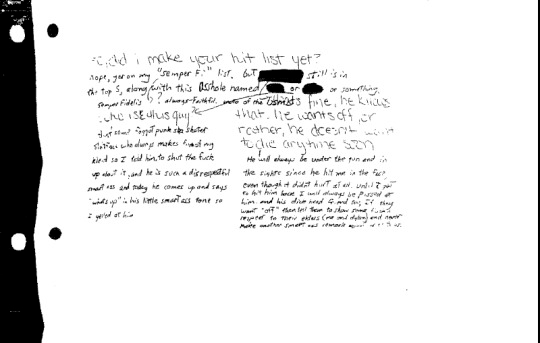
Transcript:
Kristi: did I make your hit list yet?
Eric: nope, yer on my “Semper Fi” list. but [censored] still is in the top 5, along with this asshole named [censored] or [censored] or something.
(arrow to “Semper Fi”)
Semper Fidelis >?
Eric: always faithful. motto of the USMC
Enlistment Process in the 1990s
Enlisting in the Marines in the 90s followed a fairly standard process:
- Initial meeting with a recruiter: discussing eligibility, background, and interest.
- EST test: Enlistment Screening Test is a quick 20 minute predictor for the ASVAB.
Eric scored 74/99 which was a decent enough score, confirmed by the recruiter. - 11 Traits: Applicants were presented with 11 traits picked from a survey from former marines to better understand their reasoning for joining.
Eric’s top picks were:
“Eric’s top three picks, Gonzales recalls, were psychical fitness, leadership, and management skills, and the triple-headed called self-reliance, self-direction, self-discipline, “self times three”.” -The recruiter - ASVAB test: a standardized aptitude exam that determines what military jobs (MOS) someone qualifies for.
- Background checks: including criminal record, school records, and personal history.
- Medical screening: reviewing physical health and medications.
- Delayed Entry Program (DEP): many recruits were placed in DEP before shipping to boot camp.
- Boot Camp: at Parris Island (East Coast) or San Diego (West Coast).
Recruiters
Recruiters in the 1990’s typically:
- Visited high schools.
- Met with students privately or with parents present.
- Scheduled ASVAB tests.
- Built long term contact with potential recruits.
- Reported information back to higher command for eligibility review.
They were expected to verify medical information, including prescription medications and psychological history, because those could disqualify applicants which we know to be true in Eric’s case.
Timeline
Harris’ interest in the Marines, it’s important to establish a clear timeline of his contact with a Marine recruiter leading up to the shooting. This section lays out what is known about the meetings, communications, and events that occurred as Eric explored enlistment in the spring of 1999. Where possible, direct statements from the recruiter are included to give insight into how the process unfolded.
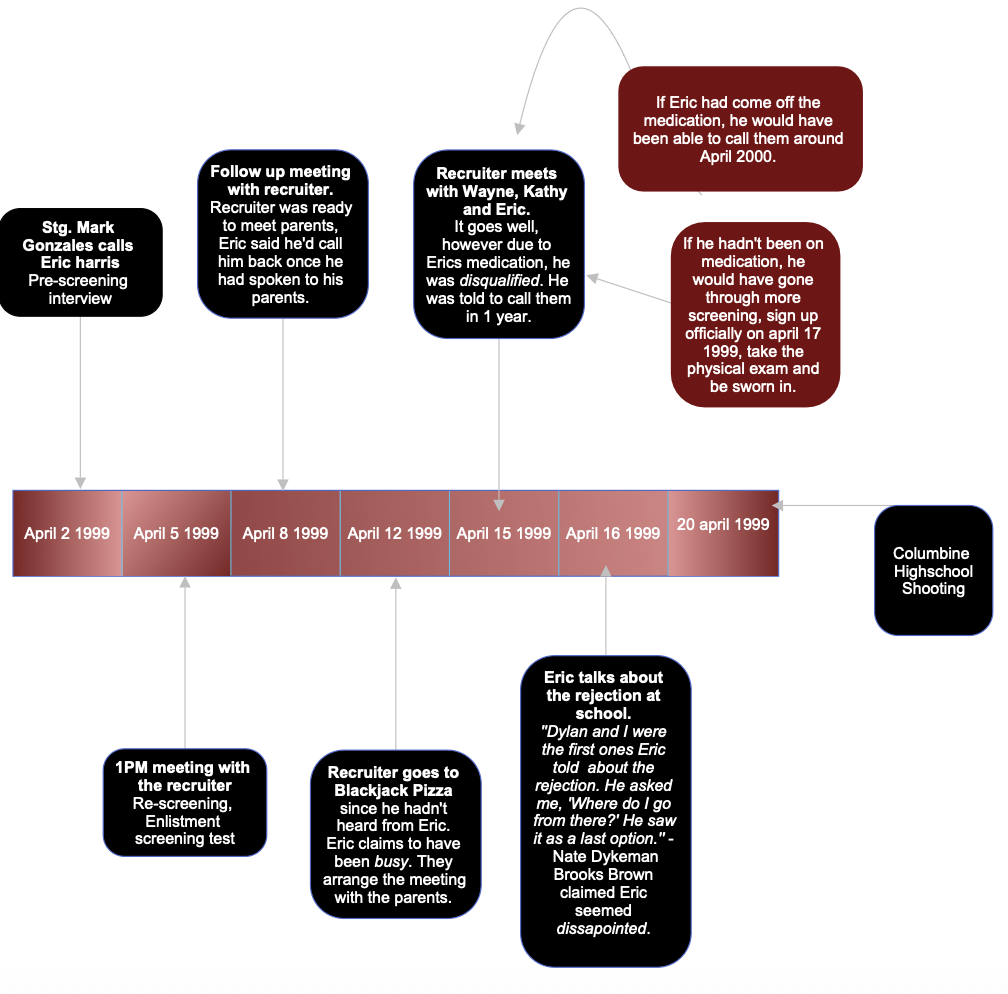
Tap to read Erics only journal entry during this time period.
Transcript:
Months have passed. Its the first Friday night in the final month. much shit has happened. Vodka has a Tec 9, we test fired all of our babies, we have 6 time clocks ready, 39 crickets, 24 pipe bombs, and the napalm is under construction. Right now I’m trying to get fucked and trying to finish off these time bombs. NBK came quick. why the fuck cant I get any? I mean, I’m nice and considerate and all that shit, but nooooo. I think I try to hard. but I kinda need to considering NBK is closing in. The amount of dramatic irony and foreshadowing is fucking amazing. Everything I see and I hear I incorporate into NBK somehow. Either bombs, clocks, guns, napalm, killing people, any and everything finds some tie to it. feels like a Goddamn movie sometimes. I wanna try to put some mines and trip bombs around this town too maybe. Get a few extra flags on the scoreboard. I hate you people for leaving me out of so many fun things. And no don’t fucking say, “well thats your fault” because it isnt, you people had my phone #, and I asked and all, but no. no no no dont let the weird looking Eric KID come along, ohh fucking nooo.
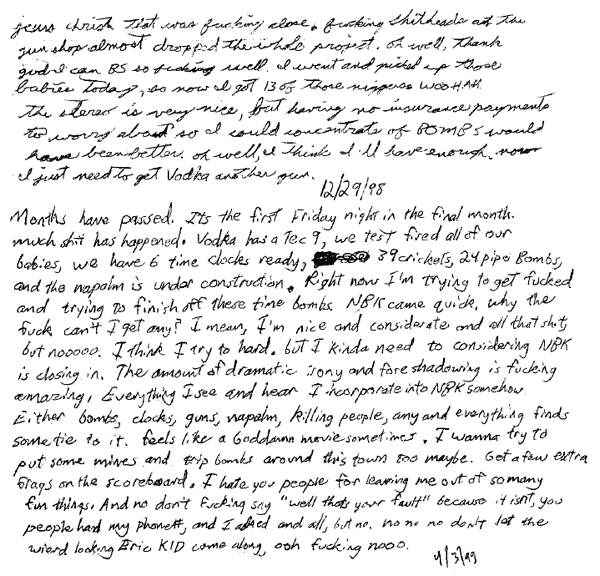
Sgt. Mark Gonzales, a former Columbine High School graduate and Marine Corps recruiter, had access to the school’s student list and phone numbers. That was how he came across Eric Harris. On April 2, 1999, Gonzales called Eric and conducted a twenty minute pre-screening interview. During this call, Eric did not disclose that he was taking medication or that he had any medical conditions. He only mentioned a broken wrist and a broken nose from childhood injuries.
At the time, Eric was taking Luvox (fluvoxamine), an SSRI prescribed for depression and obsessive-compulsive disorder. SSRIs were considered “mood altering medication,” which often raised red flags in military medical screening and could result in disqualification, depending on duration, diagnosis, and waiver policies. Eric had also been born with pectus excavatum, a congenital chest wall deformity that had required surgical correction. The condition can limit physical capacity, and depending on severity, it could also be disqualifying for Marine infantry roles without a medical waiver.
Both factors would have been significant obstacles for enlistment if disclosed honestly during screening.
Eric discussed his hobbies and grades during the call, and they arranged a follow-up meeting.
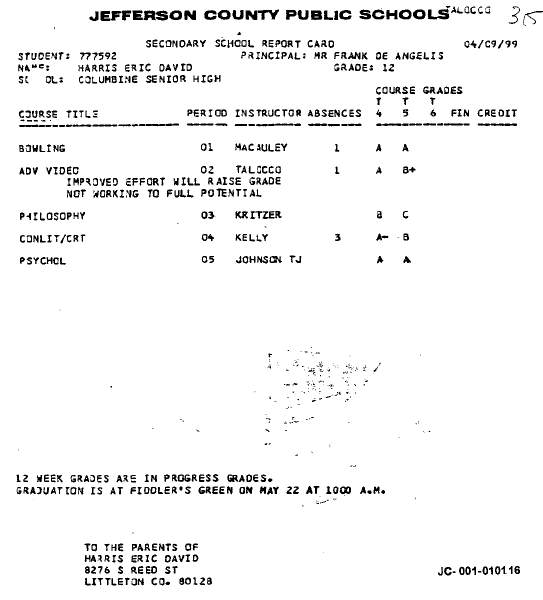
”He’s very smart.”
”I felt he might be a good lead because he thought about the Marine Corps and he was interested in weapons”
– Gonzales.
On April 5, 1999, Eric met Gonzales at the Littleton recruiting office, where he was re-screened and took the 22-minute EST, a short test measuring verbal and math skills. The average score typically falls between 40 and 60; anything above 60 allows candidates to qualify for nearly any branch or specialty.
Eric scored 74 out of 99, placing him well above average.
The Marine Corps also uses a list of eleven motivational traits, drawn from surveys of former Marines, to help understand a recruit’s reasoning for joining. According to Gonzales, Eric’s top three were physical fitness, leadership and management skills, and the combined category of “self-reliance, self-direction, self-discipline, self times three.”
Eric expressed the most interest in infantry and special forces, roles associated with physically demanding combat training and deployment.
Tap to read about the Marine Corps Special Forces now and then (MARSOC)
Marine Corps Special Forces, officially known as MARSOC (Marine Forces Special Operations Command), are an elite group within the Marines who undergo some of the most demanding training in the U.S. military. Their missions focus on counterterrorism, reconnaissance, hostage rescue, foreign internal defense, and covert operations. These Marines are selected for exceptional physical endurance, mental resilience, adaptability, and independence. Special Forces training is extremely rigorous, and only a small percentage of Marines ever qualify. It requires several years of service, a spotless record, and passing multiple selection phases.
In the 1990s, the Marine Corps did not yet have MARSOC as it exists today, but “special forces” generally referred to elite reconnaissance roles such as Force Recon, which performed deep reconnaissance and high risk direct action missions.
Tap to read about the Marine Corps Infantry now and then
Infantry is the backbone of the Marine Corps. These Marines are trained for frontline combat and are responsible for closing with the enemy, engaging in direct combat, securing terrain, and carrying out ground operations. Infantry roles include riflemen, machine gunners, mortarmen, assaultmen, and infantry squad leaders. Training is physically demanding and emphasizes weapons handling, tactics, field survival, teamwork, and endurance. While infantry is not considered “special forces,” it is still one of the most challenging and combat-intensive paths in the Marines. In the 1990s, infantry service was heavily emphasized during recruitment, especially for young men drawn to physical fitness, discipline, and action-oriented roles.
Eric told Gonzales he wanted to finish high school before officially enlisting, and Gonzales said he needed to speak with Eric’s parents. They met again on April 8, a 15 to 20 appointment during which Eric appeared committed to the idea of becoming a Marine.
”He was pretty much sold on the Marine Corps but he wanted to have the parents involved.”
– Gonzales
Eric turned eighteen the following day. By April 12, Gonzales became concerned that he had not heard from him and went to Eric’s workplace to follow up. Eric explained he had been busy, and they scheduled a meeting with his parents on April 15. The Harrises were primarily interested in educational opportunities and the Delayed Entry Program, Kathy Harris, specifically, was uneasy about combat related positions. The meeting lasted about thirty minutes and seemed to go smoothly.
Just as Gonzales was preparing to leave, Kathy stepped out of the room and returned holding Eric’s prescription bottle. “What about these?” she asked. Once the medication was confirmed as a mood altering SSRI by Kathy, Eric was considered medically disqualified and was told to contact the recruiter in a year. Gonzales said he wasn’t convinced Kathy intended to sabotage the process, she appeared genuinely interested in the college benefits the Marine Corps offered but uncomfortable with the idea of combat roles. The disappointment was mutual. Eric, his parents, and the recruiter all appeared let down. If not for the medication, Eric would have proceeded with further screening, officially signed papers on the 17th, completed a physical exam, and been sworn in.
While it’s impossible to know her exact intention, the timing of Kathy’s disclosure does raise questions. She waited until the end of a successful meeting after the recruiter, Eric, and even his father seemed encouraged before returning with the prescription bottle. Given what is known about her concerns over combat related roles, it’s reasonable to consider that she may have hoped this revelation would slow the process down or steer Eric toward a safer, education-oriented path within the delayed entry program. This wouldn’t necessarily mean she wanted to sabotage his chances entirely, but rather that she may have believed a pause or redirection was in his best interest, especially with his mental health and the risks of combat in mind as a mother. it’s also likely she assumed the Marines would simply pause the process, request medical paperwork, and revisit his eligibility later. Instead, the medication rule shut everything down on the spot. In that sense, her intervention had a far greater impact than she probably anticipated.
That same night, Eric called Mark Manes and asked him to purchase 9mm ammunition.
On April 16, Eric told friends at school that he had been rejected by the Marines. According to Brooks Brown, he seemed disappointed but tried not to show it.
Nate Dykeman later recalled:
“Dylan and I were the first ones Eric told about the rejection. He asked me, ‘Where do I go from there?’ He saw it as a last option.”
When Eric asked, “Where do I go from there?” it wasn’t a casual question. in my opinion, for him, the Marine Corps had become more than a career idea. it represented structure, identity, and a way to reinvent himself after high school. Losing that path so abruptly meant losing the one future he had allowed himself to imagine. Eric already struggled with feeling directionless and shut out, and the rejection reinforced his belief that he didn’t fit anywhere and had no meaningful options left. It’s also worth noting that Eric hadn’t sought out the Marine Corps on his own, the recruiter contacted him first. For someone who sometimes searched for signs, he may have interpreted that call as a kind of “meant to be” moment, in the same way he attached significance to KMFDM’s ADIOS album releasing on the day of the attack.
heh, get this. KMFDM’s new album is entitled “Adios” and it’s release date is in April. how fuckin appropriate, a subliminal final “Adios” tribute to Reb and Vodka. thanks KMFDM… I ripped the hell outa the system
12/20/98
When the Marine path collapsed just as suddenly as it appeared, it likely felt to him like another confirmation that even opportunities he viewed as almost fated were destined to fail. In his mind, it didn’t just close a door. It reinforced the narrative he already believed about himself and the future. That nothing would work out, even the things that seemed handed to him.
Eric diversion papers in 1998, putting the marines as a career goal.
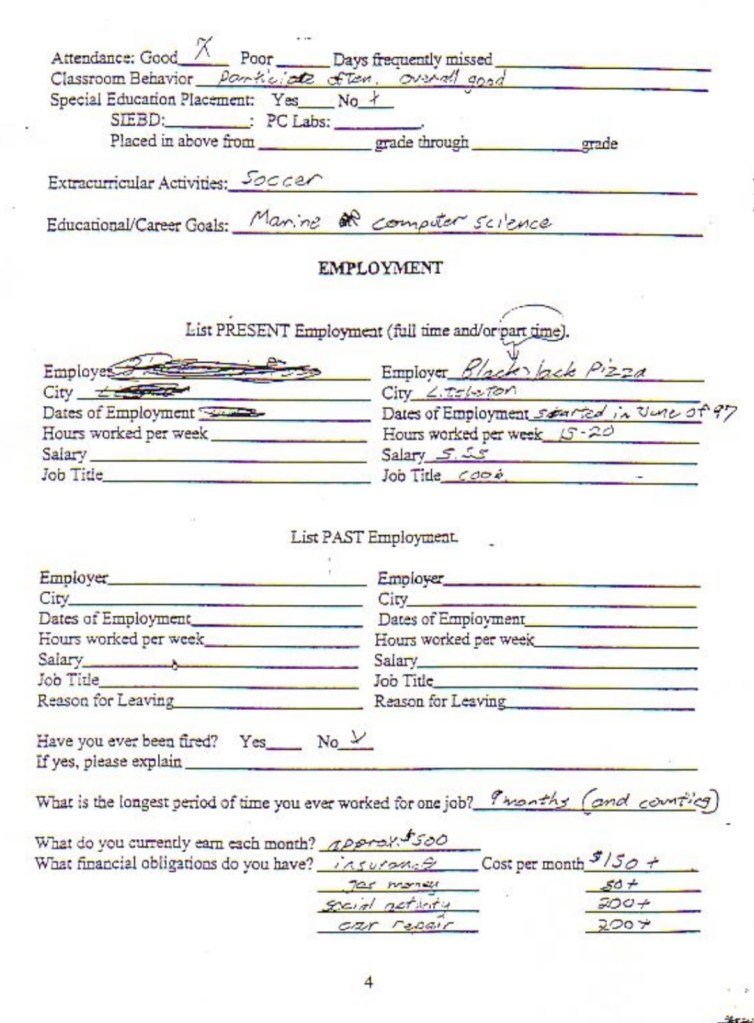
Eric family history with the military
Eric Harris grew up in a family with a military history on both sides, which may have shaped his perception of the Marines as a source of structure and identity. This background likely contributed to Eric’s fascination.
Wayne
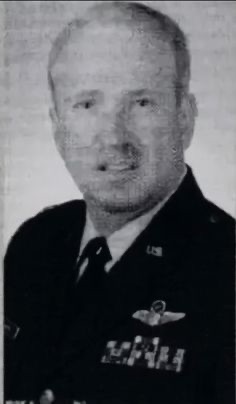
Wayne Harris served approximately 20 years in the U.S. Air Force, retiring in 1993. Over his career, he held 11 different positions across six different bases, including Wurtsmith Air Force Base in Michigan and Plattsburgh Air Force Base in New York, where he was part of the 380th Operations Support Squadron. He flew KC‑135 refueling tankersand worked as an aircraft commander and instructor, helping train other pilots. Throughout his service, he received multiple commendations, including the Meritorious Service Medal, four oak leaf clusters, two bronze service stars, and an award for small-arms marksmanship. His career required frequent relocations for his family, and after retiring from the Air Force, he worked for Flight Safety Services Corporation in Colorado, continuing to train pilots.
Kathy

Kathy Harris spent most of Eric’s childhood as a stay at home mother, focusing on creating stability while Wayne’s Air Force career kept the family moving. After the Harrises settled in Littleton following Wayne’s retirement, she took on part-time catering work.
Her father, Eric’s maternal grandfather, was a retired military office who owned an hardware store.
Kevin
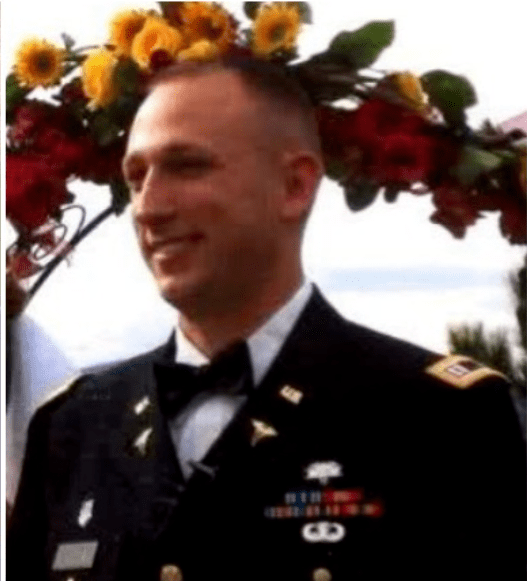
Kevin joined the Army following his college graduation which of course after the tragedy. He attended Boulder College in Colorado. While in the Army he received his master’s degree in physical therapy
Eric and the marines/military in his journal
“(…)WWII was the last war worth fighting and was the last time human life and human brains did any good any made us proud. now, with the government having scandals and conspiracies all over the fucking place and lying to everyone all the time(…)”
“(…) think “damn, we are so advanced, we kick ass, america is awesome, we have so many things in our military, we would kick anyones ass.” for a minute I actually had some pride in our nation…. then I realized, “hey, this only the Good things that I am seeing here. (…)”
“(…) and hey goddamnit I would have been a fucking great marine, It would have given me a reason to do good. and I would never drink and drive, either. (…)”
Eric’s journal entry from December 3, 1998
“(…) and hey goddamnit I would have been a fucking great marine, It would have given me a reason to do good. and I would never drink and drive, either. (…)”
Suggests he may have anticipated disqualification from the Marines well before any recruiter contact. By phrasing his thoughts as “I would have been a great Marine,” he frames it hypothetically, implying he had already been rejected or disqualified. This could explain why he never reached out to the Marines on his own or why did the recruiter had to chase him up at Blackjacks pizza. He likely assumed he would be rejected due to his medical background. When the recruiter called him months later in April, it may have felt like a rare opportunity or even a stroke of luck, a chance to explore a path he had already written off, which also helps explain why he approached the pre screening cautiously and withheld medical information.
The journal entry also reveals that, for Eric, the Marines represented more than a job, they were a potential motivator. His words, “It would have given me a reason to do good. and I would never drink and drive, either,” suggest that enlistment was tied to personal goals, structure, and a sense of purpose he felt he lacked elsewhere. The Marines were, in his mind, a path toward becoming a better version of himself.
Eric had already written the Marines off in 1998, but when they reached out in April, he may have felt a brief sense of hope, only to be crushed by the rejection. As Nate recalled, “Where do I go from there?” With the Marines off the table for at least another year, that final path of purpose was suddenly closed, leaving him without purpose just before NBK.
At this point in his life, the only thing that appeared to be going according to his plans, aside from his recent job promotion, which didn’t matter to Eric much, was his preparation and planning for NBK.
DOOM
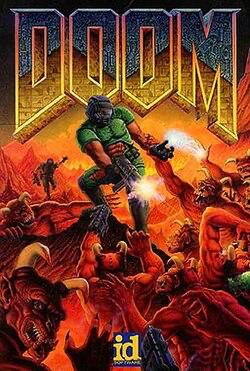
DOOM wasn’t just one of Eric’s favorite games. It was a major part of his identity and daily routine during his teenage years. He spent hours playing, modding, and creating custom levels, and he frequently referenced the game in his online posts. The protagonist of DOOM is literally a space marine, a soldier figure Eric admired from early on. This is relevant because long before he ever spoke with a real recruiter, Eric was already engaging with a fictionalized military archetype through a game he was deeply attached to.
DOOM (1993) : The original game that launched the franchise.
DOOM II: Hell on Earth (1994) : The direct sequel with new enemies and expanded content.
Ultimate DOOM (1995) : A re-release of the original with an additional fourth episode.
Final DOOM (1996) : Two full-length campaigns officially published by id Software.
DOOM (1993)
The 1993 DOOM places the player in the role of an unnamed space marine stationed on Mars’ moons, Phobos and Deimos. After a teleportation experiment goes wrong, portals to Hell open and demons overrun the bases. The marine fights his way through increasingly chaotic levels to stop the invasion.
The identity of the protagonist is straightforward: he is a Marine Corps soldier in a science fiction setting.
DOOM II (1994)
DOOM II continues directly from the first game. The player is again the same space marine, returning to Earth only to find that demons have invaded the planet. The story is minimal typical of 90s shooters, but the Marine’s role as a lone soldier fighting overwhelming odds stays central.
This sequel is the DOOM title Eric interacted with the most: the one he played heavily, modified, and created custom levels for.
The space marine
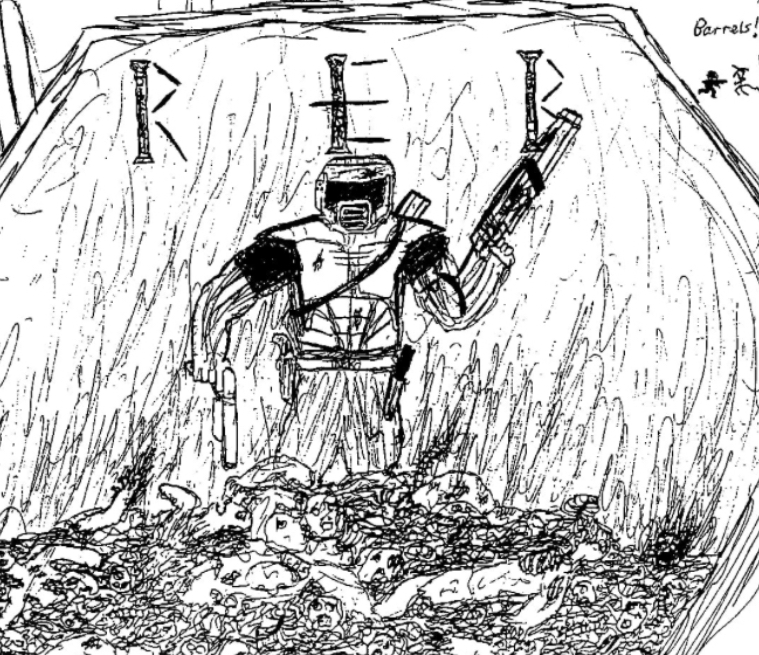
In the early DOOM canon, the protagonist was simply “the Marine,” a U.S. Marine Corps soldier with a minimal but distinct backstory. According to the original 1993 game manual, he was court-martialed and exiled to a military post on Mars after assaulting a superior officer who ordered him to fire on civilians, the only established character detail players were given at the time. He is explicitly a spacefaring Marine Corps soldier stationed at a Union Aerospace Corporation base. there, he becomes the lone survivor of a demonic invasion on Phobos and Deimos, fighting entirely alone through both DOOM and DOOM II. He has no name, no dialogue, and no personality. He exists as a silent, hyper competent soldier archetype, portrayed as muscular, relentless, and self reliant. This blank “space marine” figure was intentionally designed so players could project onto him, and he became one of the defining military images in 1990s gaming
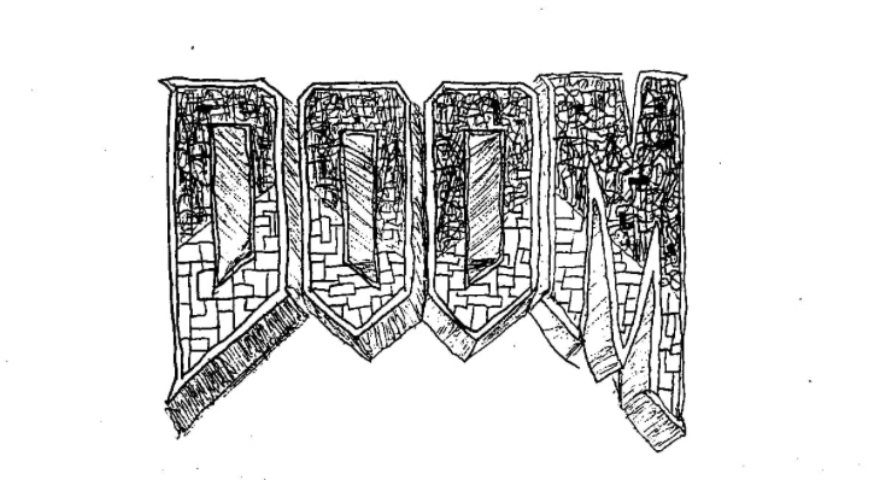
Eric moon story, clearly about doom.
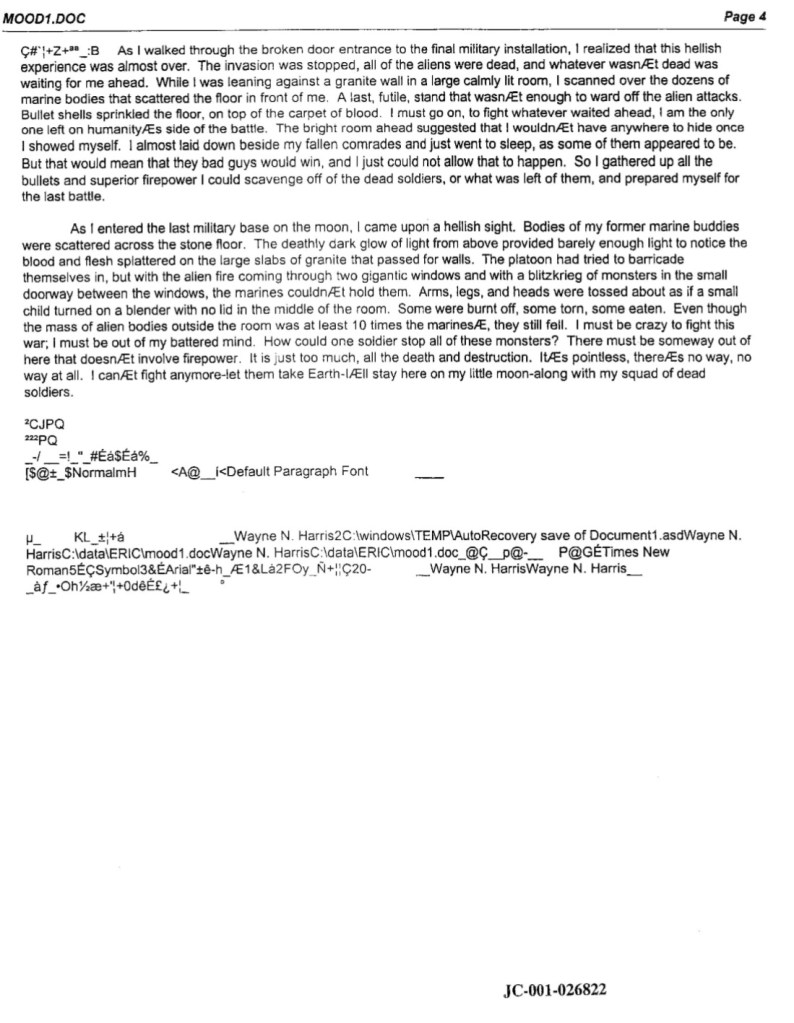
Doom referenced in his journals
”everyone should be put to a test. an ULTIMATE DOOM test, see who can survive in an environtment using only smarts and military skills. put them in a doom world. no authority, no refuge, no BS copout excuses. If you cant figure out the area of a triangle or what “cation” means, you die! if you cant take down a demon w/ a chainsaw or kill a hell prince w/ a shotgun, you die! ”
”I have a goal to destroy as much as possible so I must not be sidetracked by my feelings of sympathy, mercy, or any of that, so I will force myself to believe that everyone is just another monster from Doom like FH or FS or demons, so It’s either me or them. I have to turn off my feelings.”
”every form of gov leads to downfalls, everything will always fuck up or yeah something. its all DOOMed god damnit.”
”I dubbed my shotgun “Arlene” after Arlene Sanders from the DOOM books. She always did love the shotgun”
The journals where the excerpts are from
Download
Doom mentioned in Eric’s school work
”My love for a computer game called DOOM. Doom is such a big part of my life, and no one else I know re-creates environments of DOOM as good as me. I know almost anything there is to know about this game, so I believe that separates me from the rest of the world (…)”
1 most important thing
”Doom is so burned into my head my thoughts usually have something to do with the game. Whether it be a level or environment or whatever.
In fact a dream I had yesterday was about a “Deathmatch” level that I have never even been to. It was so vivid and detailed I will probably try to recreate it using a map editor. It had 3 ledges and a very high tree-house-like area also, but describing it would take forever. What I can do in real life, I try to do in doom. Like if I walk by a small building I would recreate it as good as I could and then explore it, go on the roofs, under it, or even shoot at it. The fact is, I love that game and if others tell me “Hey it’s just a game!” I say “Hey I don’t care.”
”Doom is a first-person “shoot-em-up” style game. So basically, one runs around levels and shoots at monsters with military weaponry. To most people it may be just another silly computer game, but to me it is an outlet for my thoughts and dreams. I have mastered changing anything that is possible to change in that game, such as the speed of weapons, the strength and mass of monsters, the textures and colors used on the floors and walls, and greatest of all, the actual levels that are used. Several times I have dreamed of a place or area one night, and then thought about it for days and days. Then, I would recreate it in Doom using everything from places in outer space with burned-out floor lights and dusty computers to the darkest depths of the infernal regions with minotaurs and demons running at me from every dark and threatening corner. I have also created settings such as eras of ancient abandoned military installations deep in monster-infested forests with blood stained trees and unidentifiable mangled bodies covered with dead vines and others that portray to futuristic military bases on Mars overrun with zombies that lurk in every corner. These places may seem a bit on the violent side and, I assure you, some of them are. However, many times I have made levels with absolutely no monsters or guns in them. I have created worlds with beautiful, breath taking scenery that looks like something out of a science fiction movie, a fantasy movie, or even some “eldritch” from H. P. Lovecraft.
Now, I know that other people are just as creative or more creative than I am, but I believe that I will always be the best at Doom creativity. In this day and age it can be hard to find a skill that can be completely dominated and mastered or a skill that almost no one else has. This is why I choose a simple computer game to express my talents.”
DOOM was not just a small time hobby for Eric. It was very clearly a major part of his daily life and identity. He wrote extensively about it, describing how his thoughts often revolved around the game’s levels and environments, how he recreated dreams and real-world spaces in its maps, and how he mastered every aspect of gameplay and modification.
The protagonist, a space marine armed with military weapons, was a figure Eric engaged with constantly, through both play, drawings and creative level design. Combined with his family’s military background, this exposure to military archetypes, along with his love of weapons and tactical gameplay, helps contextualize why Eric considered being a marine.
With that context in place, it makes sense to look next at how Eric wrote about the actual Marines in his school assignments and others.
Erics assignment and other writings mentioning Marines specifically
Let’s turn the clock back to 1995 and look at one of Eric’s earliest school assignments involving the military that is published.
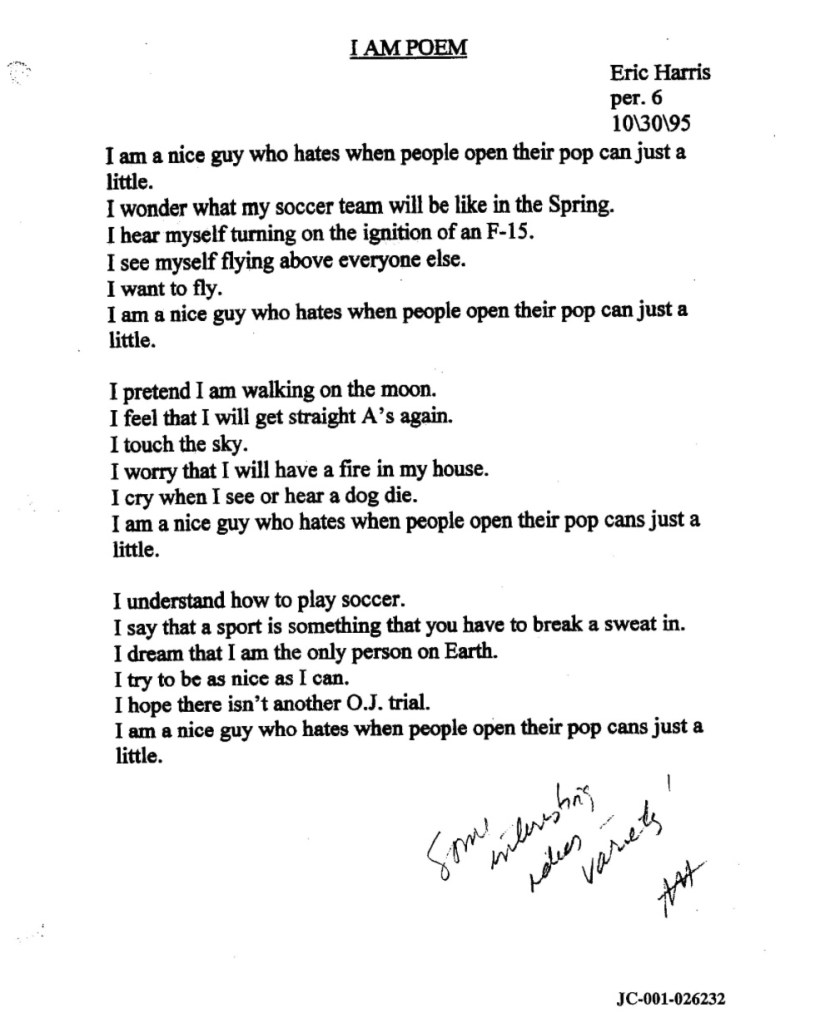
In this piece, written when he was younger, Eric describes hearing “the ignition of an F-15” as he turns it on and imagining himself flying above everyone else. For most readers, an F-15 might not mean much beyond “a plane,” so it’s worth clarifying what he was referencing.
tap for F-15 and the airfare
The F-15 Eagle is a twin engine, supersonic air superiority fighter used primarily by the United States Air Force. Introduced in the 1970s, it was designed for speed, maneuverability, and dominance in aerial combat. Capable of reaching around Mach 2.5 and climbing to roughly 65,000 feet, the aircraft’s high thrust to weight ratio allows for exceptional acceleration and tight turning performance. It carries a 20 mm M61A1 cannon along with a variety of air to air missiles, supported by advanced radar and avionics for long range detection and engagement. The Eagle became one of the Air Force’s most reliable and successful fighters, later evolving into variants like the two seat F-15E Strike Eagle, which added ground attack capability while retaining the platform’s impressive performance.
Eric’s earliest military ambition may have been the Air Force rather than the Marines.
In 1995, he imagined ”turning on the ignition of an F-15” and ”flying above everyone else,” and even stating, ”I want to fly”, likely inspired by his father’s career and the prestige of one of the Air Force’s most powerful fighters. By the late 1990s, however, his focus shifted toward the Marines. A transition I believe was influenced in part by Doom, a game centered on a space marine navigating challenging combat environments. The Air Force dream reflects early admiration and aspiration, while the Marine interest shows how his ambitions evolved as he encountered new influences.
While the F-15 assignment shows his early military interest, his later schoolwork reveals how he viewed the Marines in particular. Let’s take a closer look at where he mentioned them.
Marine/hunter
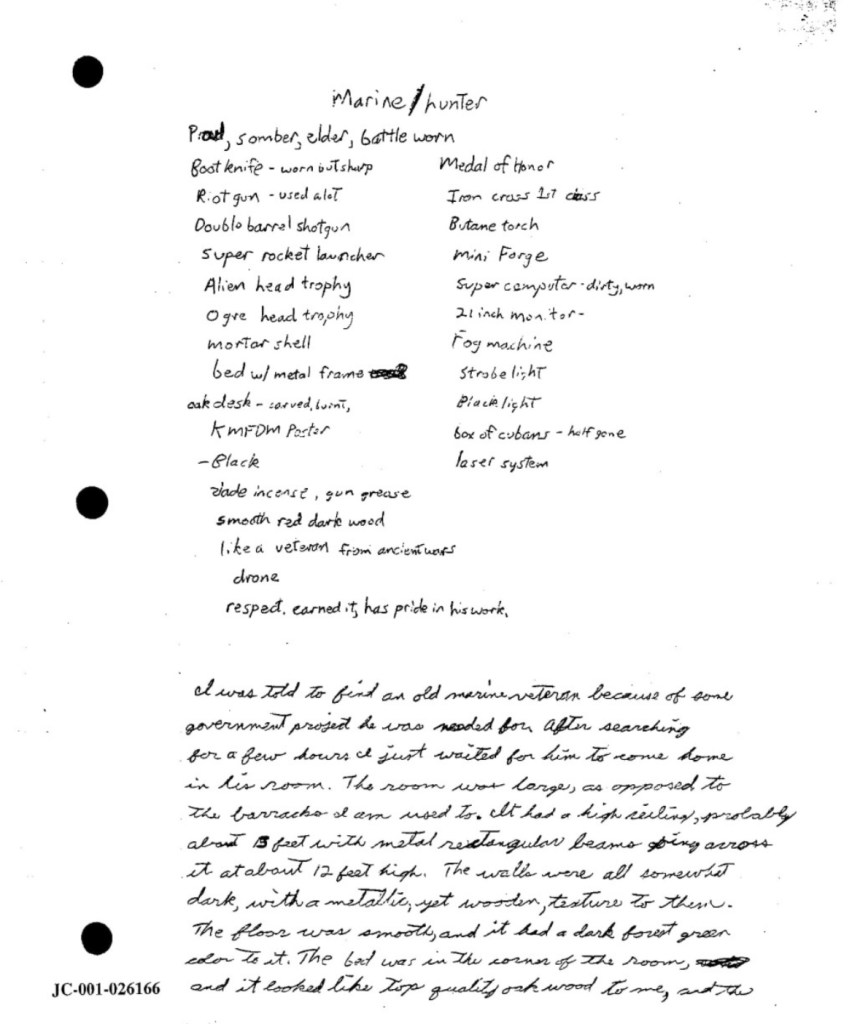
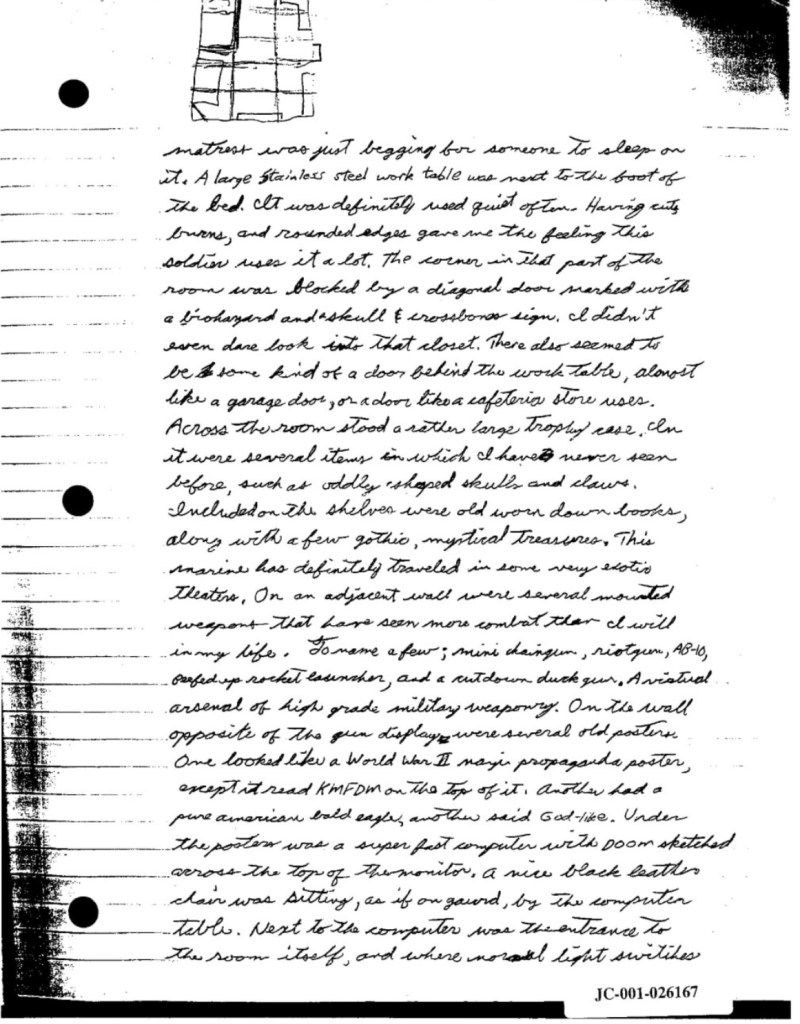
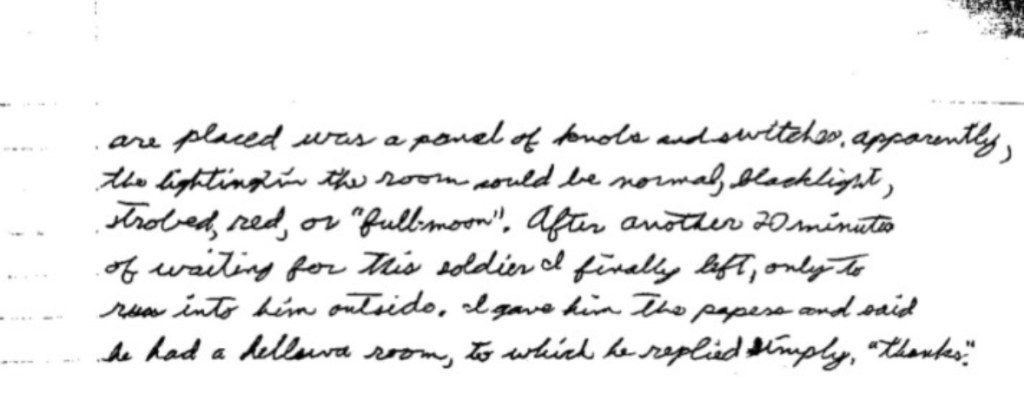
Transcript:
Marine/hunter
Proud, somber, older, battle worn
Boot knife – worn & sharp
Riot gun – used a lot
Double barrel shotgun
Super rocket launcher
Alien head trophy
Ogre head trophy
Mortar shell
Bed w/ metal frame oak desk – carved, worn
KMFDM poster –
Glacier
blade incense, gun grease
smooth red dark wood
like a veteran from ancient wars
drone
respect, earned it, has pride in his workMedal of honor
Iron cross 1st class
Butane torch
Mini forge
Super computer – dirty, worn
21 inch monitor
Fog machine
Strobe light
Blacklight
Box of cubans – half gone
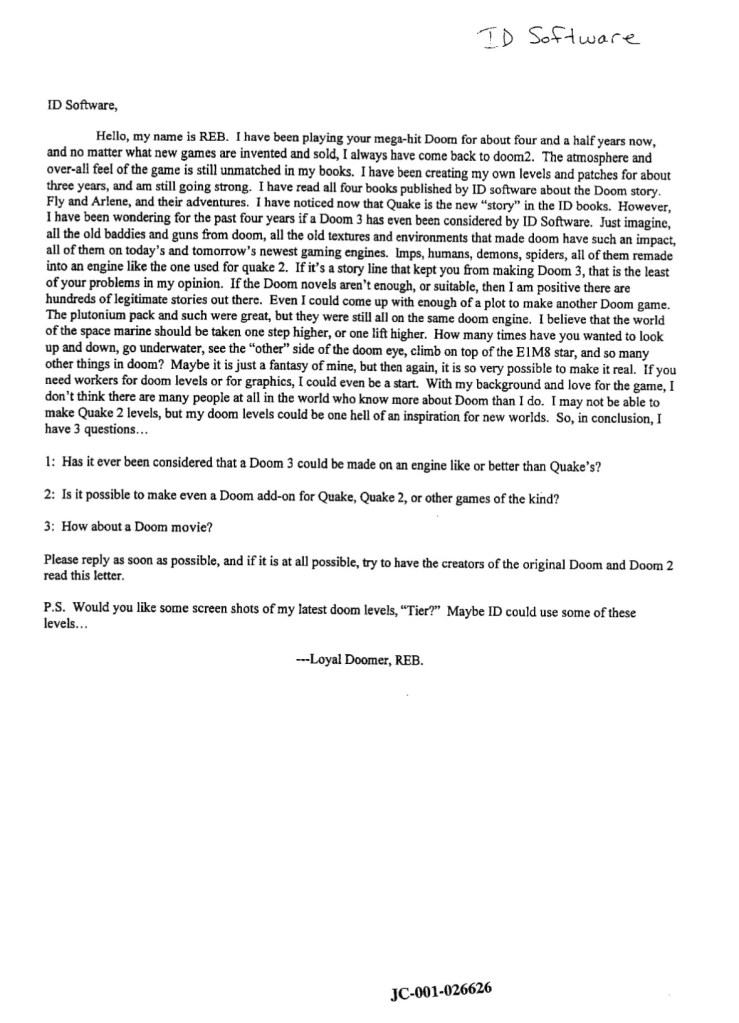
laser systemI was told to find an old marine veteran because of some government project he was needed for. After searching for a few hours I just waited for him to come home in his room. The room was larger, as opposed to the barracks I am used to. It had a high ceiling, probably about 18 feet with metal rectangular beams going across it about 12 feet high. The walls were all somewhat dark, with a metallic, yet wooden, texture to them. The floor was smooth, and it had a dark forest green color to it. The bed was in the corner of the room, and it looked like top-quality oak wood to me, and the mattress was just begging for someone to sleep on it. A large stainless steel work table was next to the foot of the bed. It was definitely used quite often. Having cuts, burns, and rounded edges gave me the feeling this soldier uses it a lot. The corner in that part of the room was blocked by a diagonal door marked with a biohazard and skull & crossbones sign. I didn’t even dare look into that closet. There also seemed to be some kind of a door behind the work table, almost like a garage door, or a door like a cafeteria store room. Across the room stood a rather large trophy case. On it were several items in which I haven’t never seen before, such as oddly shaped skulls and claws. Included on the shelves were old worn-down books, along with a few exotic, mystical treasures. This marine has definitely traveled in some very exotic theaters. On an adjacent wall were several mounted weapons that have seen more combat than I ever will in my life. To name a few; mini-gun, nitro-gun, M-16, anti-super rocket launcher, and a neutron duke gun. A varied arsenal of high grade military weaponry. On the wall opposite of the gun display were several old posters. One looked like a World War II nazi propaganda poster, except it read KMFDM on the top of it. Another had a pure american bald eagle, and one said Godlike. Under the posters was a super fast computer with DOOM sketched across the top of the monitor, a nice black leather chair was sitting, as if on guard, by the computer table. Next to the computer was the entrance to the room itself, and where several light switches are placed was a panel of knobs and switches, apparently, the lighting in the room would be normal, blacklight, strobe, red, or ‘full moon’. After another 20 minutes of waiting for this soldier I finally left, only to run into him outside. I gave him the papers and said he had a helluva room, to which he replied simply, ‘Thanks.’”
This shows how his military fantasies evolved. In 1995 he imagined himself flying an F-15 almost certainly influenced by his father’s Air Force career. But by the time he wrote this “old marine veteran” piece, his interests had shifted. The room, My dive on Erics bedroom, he describes is filled with Doom, weapons, machinery, KMFDM, and details that directly mirror his own bedroom. He mentions things he personally liked from his computer, cigars, Nazi propaganda/iron cross. It reads less like a portrait of a stranger and more like a projection of who he imagined himself becoming or wanting to be.
An older, hardened, well traveled Marine who embodies the skills, aesthetics, and identity he was gravitating toward in his later teens. In that sense, it marks the transition from an Air-Force inspired dream of flight to a Doom inspired marine persona.
The battered marine
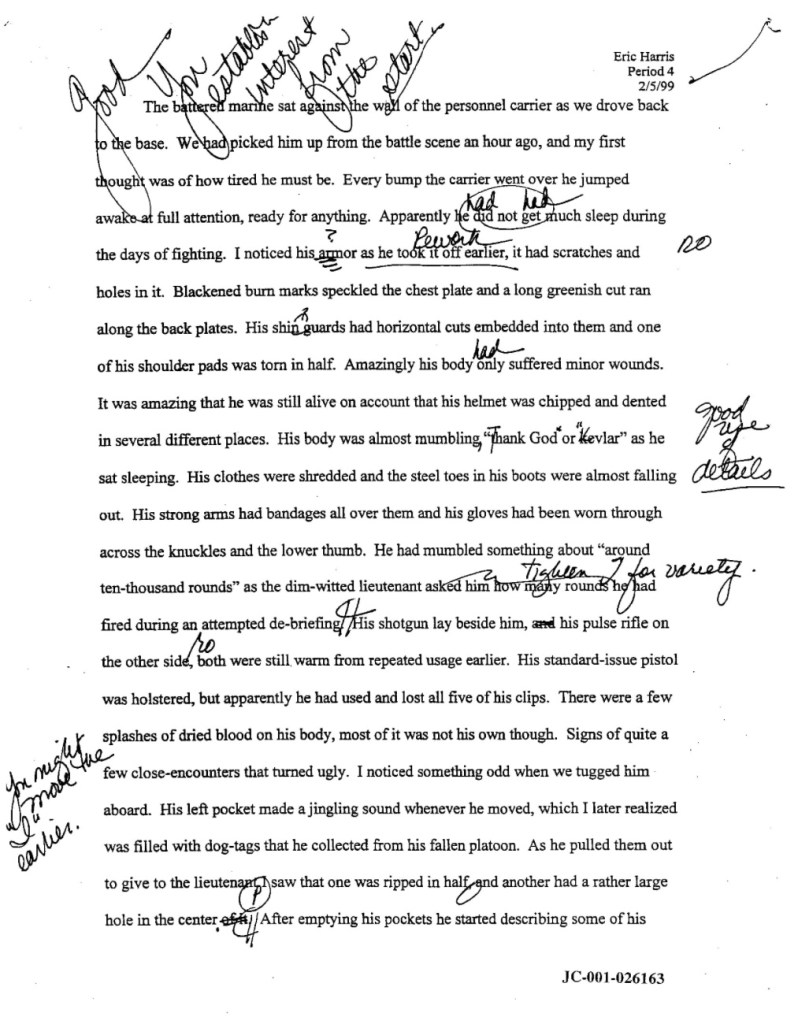
Transcript:
The battered marine sat against the wall of the personnel carrier as we drove back
to the base. We had picked him up from the battle scene an hour ago, and my first
thought was of how tired he must be. Every bump the carrier went over he jumped
awake at full attention, ready for anything. Apparently he did not get much sleep during
the days of fighting. I noticed his armor as he took it off earlier, it had scratches and
holes in it. Blackened burn marks speckled the chest plate and a long greenish cut ran
along the back plates. His shin-guards had horizontal cuts embedded into them and one
of his shoulder pads was torn in half. Amazingly his body only suffered minor wounds.
It was amazing that he was still alive on account that his helmet was chipped and dented
in several different places. His body was almost mumbling “thank God for kevlar” as he
sat sleeping. His clothes were shredded and the steel toes in his boots were almost falling
out. His strong arms had bandages all over them and his gloves had been worn through
across the knuckles and the lower thumb. He had mumbled something about “around
ten-thousand rounds” as the dim-witted lieutenant asked him how many rounds he had
fired during an attempted de-briefing. His shotgun lay beside him, and his pulse rifle on
the other side, both were still warm from repeated usage earlier. His standard-issue pistol
was holstered, but apparently he had used and lost all five of his clips. There were a few
splashes of dried blood on his body, most of it was not his own though. Signs of quite a
few close-encounters that turned ugly. I noticed something odd when we tugged him
aboard. His left pocket made a jingling sound whenever he moved, which I later realized
was filled with dog-tags that he collected from his fallen platoon. As he pulled them out
to give to the lieutenant, I saw that one was ripped in half and another had a rather large
hole in the center of it. After emptying his pockets he started describing some of his
…
”Thank god for kevlar”
“Thank God for kevlar” basically means he’s lucky to be alive because his kevlar armor protected him.
Kevlar is the tough, bullet-resistant material used in vests and military gear.
In the text, the marine’s armor is shredded, burned, and dented.
In this second assignment, Eric again writes about a Marine, but in a more realistic, grounded way. The description focuses on standard military gear. Kevlar armor, dog tags, a pistol, a pulse rifle and shotgun, fatigues, a personnel carrier, and references to a lieutenant. The Marine is portrayed as exhausted, injured, and returning from combat. What this shows, simply and clearly, is that Eric was already choosing Marines as subjects in his schoolwork, and that he had enough familiarity with basic military terminology and imagery to write about it in detail.
Open topic
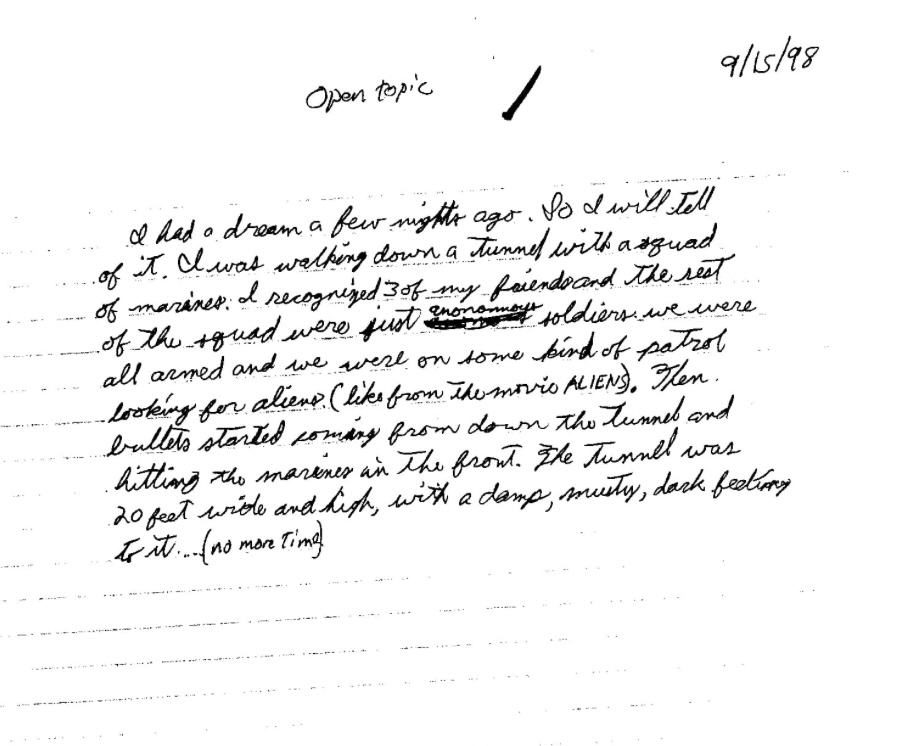
9/15/98
Open topic
“I had a dream a few nights ago. So I’ll tell of it. I was walking down a tunnel with a squad of marines. I recognized 3 of my friends and the rest of the squad were just anonymous soldiers. We were all armed and we were on some kind of patrol looking for aliens (like from the movie ALIENS). Then bullets started roaring from down the tunnel and hitting the marines in the front. The tunnel was 20 feet wide and high, with a damp, musty, dark feeling to it… (no more time).”
In this third assignment, dated 9/15/98, Eric again places himself in a military scenario, this time as part of a squad of Marines on patrol with his friends as well. The setting is more science fiction inspired, referencing Aliens, but the core framework remains the same. Even in a brief, unfinished piece, he defaults to the Marine identity and uses it as the narrative lens in this open topic. It’s another example of how frequently the Marine theme appeared in his writing, regardless of whether the scene was realistic or fictional.
Excerpt from a part of one, with the marines briefly mentioned.
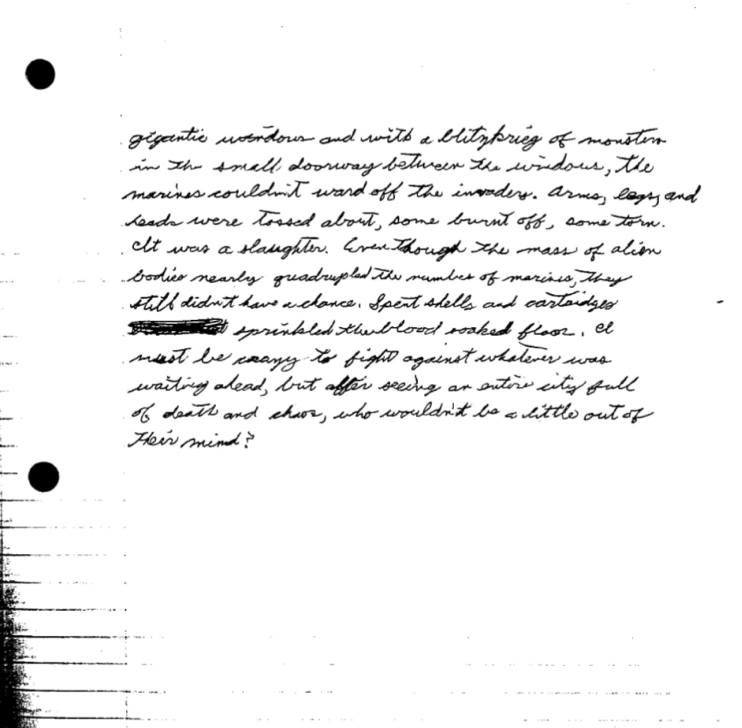
transcript:
“…gigantic windows and with a blitzkrieg of monsters in the small doorway between the windows, the marines couldn’t ward off the invaders. Arms, legs, and heads were tossed about, some burnt off, some torn. It was a slaughter. Even though the mass of alien bodies nearly quadrupled the numbers of marines, they still didn’t have a chance. Spent shells and cartridges sprinkled the blood-soaked floor. It must be scary to fight against whatever was waiting ahead, but after seeing an entire city full of death and chaos, who wouldn’t be a little out of their mind?”
Intense visual description, clear atmosphere, and consistent tone. Nothing new to add beyond that.
In Dylans notebooks in class.
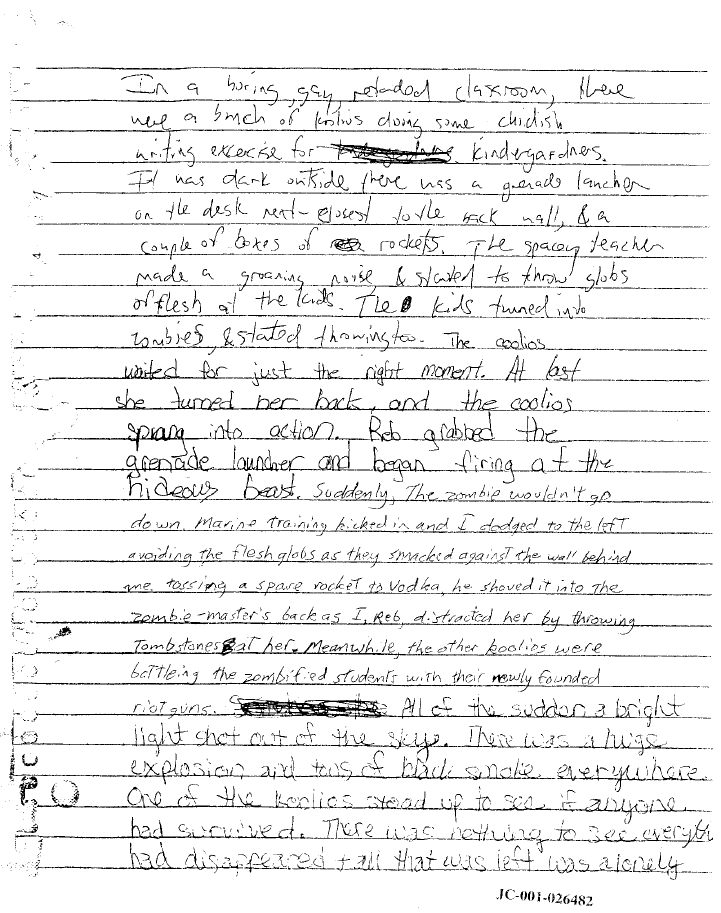
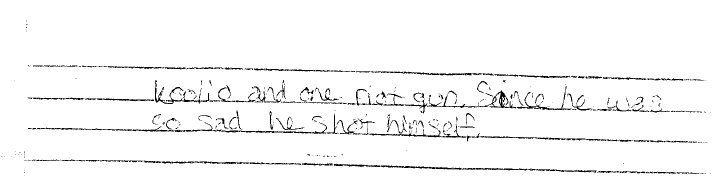
transcript:
[Dylan’s writing]
In a boring, gay, retarded classroom, there were a bunch of koolios doing some childish writing exercise for kindergardners. It was dark outside. there was a grenade lancher on the desk next-closest to the back wall, & a couple of boxes of rockets. The spacey teacher made a groaning noise, & started to throw globs of flesh at the kids. The kids turned into zombies, & started throwing too.
[Someone else’s writing]
The coolios waited for the right moment. At last she turned her back, and the coolios sprang into action. Reb grabbed the grenade launcher and began firing at the hideous beast.
[Eric’s writing]
Suddenly, The zombie wouldn’t go down. Marine training kicked in and I dodged to the left avoiding the flesh globs as they smacked against the wall behind me. tossing a spare rocket to Vodka, he shoved it into the zombie-master’s back as I, Reb, distracted her by throwing Tombstones at her. Meanwhile, the other koolios were battleing the zombified students with their newly founded right guns.
[Fourth person’s writing]
All of the sudden a bright light shot out of the sky. There was a huge explosion and tons of black smoke everywhere. One of the koolios stood up to see if anyone had survived. There was nothing to see everything had disappeared & all that was left was a lonely koolio and one riot gun. Since he was so sad he shot himself
What stands out in Eric’s section is that he’s the only one who explicitly inserts ‘Marine training’ and frames himself as a marine, with that kind of knowledge. The others keep the scene in a silly, fictional classroom zombie setting, while Eric immediately shifts into a tactical, military perspective. Even when everyone is messing around, he defaults to that identity in a way the others don’t.
Beyond his school assignments, Eric also created a personal ‘Rebels Phonetic Alphabet and Code System.’ Like his writing exercises, it reflects his military inspired mindset commands, formations, and callouts structure his own imagined operations, showing how consistently he gravitated toward the Marine identity.
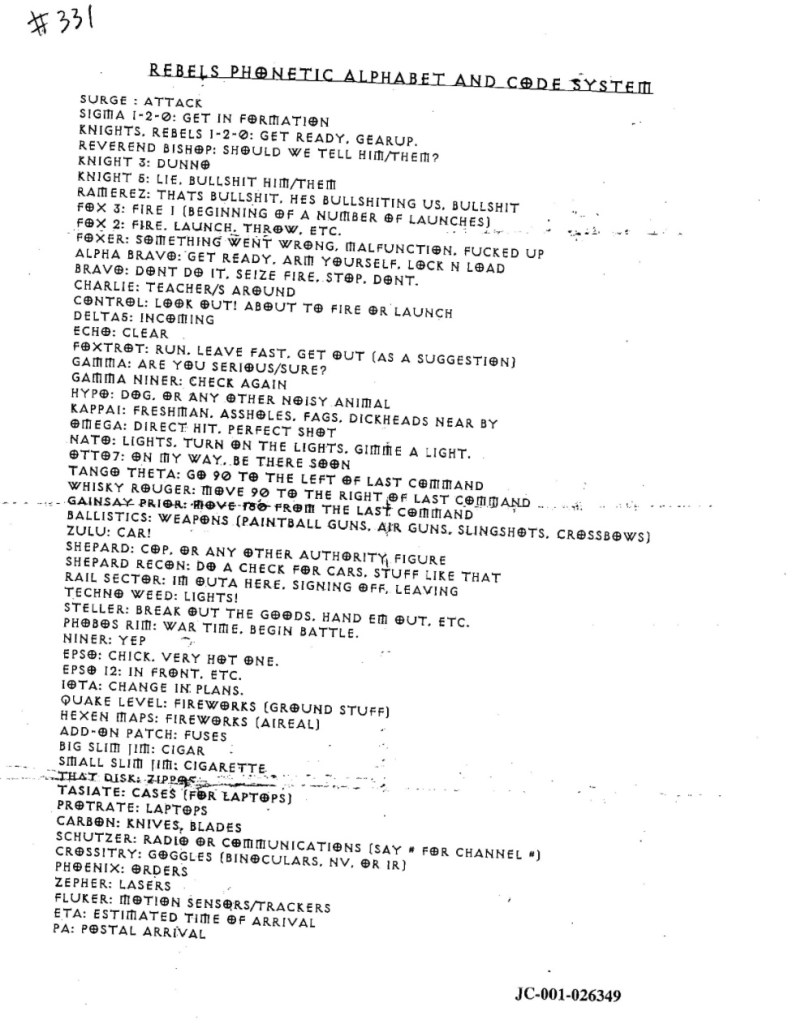
REBELS PHØNETIC ALPHABET AND CØDE SYSTEM
SURGE: ATTACK
SIGMA 1-2-0: GET IN FORMATION
KNIGHTS, REBELS 1-2-0: GET READY, GEARUP.
REVEREND BISHØP: SHOULD WE TELL HIM/THEM?
KNIGHT 3: DUNNO
KNIGHT 5: LIE. BULLSHIT HIM/THEM
RAMIREZ: THATS BULLSHIT. HES BULLSHITING US. BULLSHIT
FØX 3: FIRE! (BEGINNING OF A NUMBER OF LAUNCHES)
FØX 2: FIRE. LAUNCH. THROW. ETC.
FØXER: SOMETHING WENT WRONG. MALFUNCTION. FUCKED UP
ALPHA BRAVØ: GET READY. ARM YOURSELF. LOCK N LOAD
BRAVØ: DONT DO IT. SEIZE FIRE. STOP. DONT.
CHARLIE: TEACHERS AROUND
CØNTROL: LOOK OUT! ABOUT TO FIRE OR LAUNCH
DELTA: INCOMING
ECHØ: CLEAR
FØXTROT: RUN. LEAVE FAST. GET OUT (AS A SUGGESTION)
GAMMA: ARE YOU SERIOUS/SURE?
GAMMA NINER: CHECK AGAIN
HYPE: DOG. OR ANY OTHER NOISY ANIMAL
KAPPA: FRESHMAN. ASSHOLES. FAGS. DICKHEADS NEAR BY
ØMEGA: DIRECT HIT. PERFECT SHOT
NATO: LIGHTS. TURN ON THE LIGHTS. GIMME A LIGHT.
ØTTØ: ON MY WAY. BE THERE SOON
TANGO THETA: GO TO THE LEFT OF LAST COMMAND
WHISKY RØGUE: MOVE 90 TO THE RIGHT OF LAST COMMAND
GAINSAY PRIØR: MOVE TO FROM THE LAST COMMAND
BALLISTICS: WEAPONS (PAINTBALL GUNS, AIR GUNS, SLINGSHOTS, CROSSBOWS)
ZULU: CAR
SHEPARD: COP. OR ANY OTHER AUTHORITY FIGURE
SHEPARD RECON: DO A CHECK FOR CARS. STUFF LIKE THAT
RAIL SECTOR: IM OUTTA HERE. SIGNING OFF. LEAVING
TECHNO: WEED. LIGHTS!
STELLER: BREAK OUT THE GOODS. HAND EM OUT. ETC.
PHØBOS RIM: WAR TIME. BEGIN BATTLE
NINER: YEP
EPSØ: CHICK. VERY HOT ONE.
EPSØ 12: IN FRONT. ETC.
IØTA: CHANGE IN PLANS.
QUAKE LEVEL: FIREWORKS (GROUND STUFF)
HEXEN NAPS: FIREWORKS (AERIAL)
ADD-ØN PATCH: FUSES
BIG SLIM JIM: CIGAR
SMALL SLIM JIM: CIGARETTE
THAT DISK: LAPTOPS
TASIATE: CASES (FOR LAPTOPS)
PROTRATE: LAPTOPS
CARBØN: KNIVES. BLADES
SCHUTZER: RADIO OR COMMUNICATIONS (SAY # FOR CHANNEL #)
CROSSTRY: GOGGLES (BINOCULARS. NV, OR IR)
PHØENIX: ØPERS
ZEPHER: LASERS
FLUKER: MØTION SENSØRS/TRACKERS
ETA: ESTIMATED TIME OF ARRIVAL
PA: POSTAL ARRIVAL
What is the phonetic alphabet and why use a code system?
In the military, phonetic alphabets and code systems are used to improve clarity, speed, and accuracy of communication, especially in high stress or noisy environments. The most well known is the NATO phonetic alphabet (Alpha, Bravo, Charlie, etc.), which allows letters and words to be clearly understood over radio or phone even when signals are poor. Code systems supplement this by assigning specific phrases, numbers, or terms to actions, commands, locations, or warnings. They are widely used across branches like the Army, Navy, Air Force, and Marines, including in radio and telephone communication, air and naval operations, ground combat coordination, training drills, and special operations for operational security. Together, phonetic alphabets and codes reduce confusion, standardize instructions, and ensure all personnel can follow orders effectively.
Though purely imaginative, Eric’s system shows how central the Marine identity was to him.
Foundations of Military aspiration
According to a longitudinal study by Jackson et al. (2012), individuals who enlist in the military after graduation are more likely to have had lower scores in agreeableness, openness, and neuroticism in high school. Traits that correlate with a preference for structure, discipline, and rule‑based environments. PubMed / longitudinal study Eric’s repeated attraction to military themes, structured code systems, and identity based writing could be seen as aligning with this pattern. Still, this does not imply a clinical profile or guarantee that he would have even been suited for real military service.
Personality and Military Enlistment
Psychologists often use the “Big Five” traits to describe personality. Three traits are especially relevant when looking at who chooses a military path:
- Agreeableness: How cooperative or trusting someone is. Lower agreeableness often means a more independent, competitive approach.
- Openness to Experience: How curious or adventurous someone is. Lower openness often aligns with a preference for structure and rules.
- Neuroticism: How prone someone is to stress or emotional ups and downs. Lower neuroticism generally indicates calmness under pressure.
Research suggests that individuals with lower scores in these traits are statistically more likely to enlist, though it’s a general pattern, not a prediction.
finale timeline
10/30/1995
Eric first mentions the air-force in this writingIn January 1998 Eric and Dylan breaks into a van
In April 1998 Eric gets prescribed Zoloft due to his diversion papers he filled out. (racing thoughts, feeling down, suicidal thoughts etc..)
Soon after he describes troubles with the medication, has a two week break with no medication and gets prescriped Luvox instead.
12/03/1998
“(…) and hey goddamnit I would have been a fucking great marine, It would have given me a reason to do good. and I would never drink and drive, either. (…)”
By 1998 he has multiple assignments pertaining the marines as well as deep into his love for DooM.04/02/1999
First contact from the marine recruiter04/15/1999
Rejected from the Marines04/16/1999
Indicates to friends he doesn’t know where to go from there04/20/1999
Columbine High School Shooting
In conclusion, Eric’s interest in the military was not superficial. It was a recurring theme in his life from a young age. His 1995 and later school assignments, his fascination with military simulations in DOOM, and the creation of his own phonetic alphabet and code system all demonstrate a long standing engagement with military identity and structure. As he himself wrote, he believed he would have been a good Marine, likely understanding that his medical history, particularly his prescription medication, would prevent official enlistment.
It’s worth noting that these medications, in his case, should arguably have been prescribed only as a last resort. In the 90’s a lot of these medications were handed out without proper diagnostics, other people have shared similar experiences in the 90’s. Including that once they described side effects, the doctors just piled on more medication on them. A lot of younger people reported distortion in personality and thoughts.
By taking them in 1998, he was immediately disqualified from the Marines, closing off a path that could have aligned with his developing interests and ambitions. Eric’s growing interest in the military could have been tapped as a positive outlet, a motivator to channel his energy, discipline, and creativity especially during his diversion work.
This awareness may explain why his meetings with the recruiter were somewhat half hearted, even as he allowed himself a brief glimmer of hope. His disappointment, as shared with his friends, shows how he craved a sense of purpose and personal achievement.
While it is impossible to know how he would have fared in service, it is clear that he envisioned himself in this role for years, developing skills, knowledge, and identity around it. The rejection left him without the sense of accomplishment and direction he had briefly imagined, and the Marines door closing may have intensified his fixation on the only goal/purpose he felt remained within reach, solidifying his belief that he didn’t belong in this society.
 Echoes in the Columbine Archive
Leave a comment